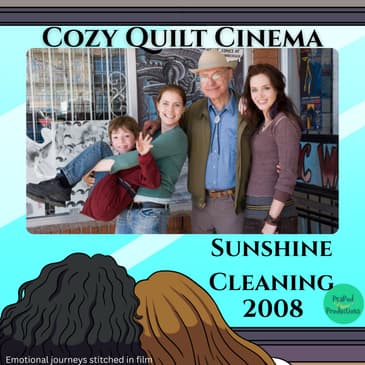
This week Beth and Michelle grab their throws for Sunshine Cleaning (2008), the dramedy about two semi-estranged sisters, played by Amy Adams and Emily Blunt, who start a crime scene and biohazard cleanup business in Albuquerque, New Mexico to fix their money troubles. What they end up cleaning up is a lot bigger than blood stains.
***This episode does discuss suicide and death in detail. If that's not where you're at right now, it's okay to sit this one out and come back next week.
Beth and Michelle talk about the grief this family never processed after their mother's suicide, why "comedy" might be the wrong label for this one entirely, and the kintsugi of it all, the way some things get repaired without ever being hidden. They dig into Rose and Nora's estranged closeness, why Winston might be the only steady man in the whole movie, and that one detail about shoes being too small that neither of them saw coming.
Also featured: Alan Arkin and Steve Zahn, a soapbox moment about growing past the jokes we were raised on, and a Stitch Count of 7 out of 9, one of the higher scores we've handed out.
Grab your Mimi's Sunshine Chanel throw, get in the blanket, and let's talk about it.
[00:00:00] The fact that they were kind of looking at her like she's crazy for wanting to do this job. Well, somebody has to do these fucking jobs, people. Whether you're a housekeeper or you like to clean crime scenes, welcome to this week's episode of Cozy Quilt Cinema. I'm Michelle.
[00:00:29] And I'm Beth, currently running a two-woman biohazard cleanup company out of a beat-up van, mostly held together by Denial and a really good playlist. Every week, Michelle and I curl up on the couch and we watch a movie and just talk about it and how it makes us laugh or cry. How it makes us sit on the edge of our seats or maybe even lean into a loved one. So grab your Mimi Sunshine Chanel throw and get in the blanket fort. Let's talk about it.
[00:00:59] So yes, this week we are doing sunshine cleaning. I always say it wrong. Cleaning. Cleaning. I wanted to say cleaners. It's written right in front of me. Yes. Sunshine Cleaning from 2008. Yes. You want me to tell you about the film? Sure, you go for it. Let me do that. So it's a comedy drama about two estranged-ish sisters, Rose and Nora Lurowski. Lurowski? Yeah, that's right.
[00:01:28] It's not a Beth show if Beth isn't mispronouncing something or at least questioning it. Who start a crime scene and biohazard cleanup business in Albuquerque, New Mexico, hoping to fix their money troubles. Along the way, they end up scrubbing at something much bigger than bloodstains. The grief they never processed after their mother's suicide and the mess of who they've each become since. It's sad, funny, a little squeamish, and unexpectedly tender.
[00:01:59] And that is the film. Yes. Unfortunately, I've had a cat jumping on me nonstop as we were doing that. Yeah, I had not seen this movie when it came out and I don't know justifiably why other than I don't think I was going to the movies very often in 2008. I was doing a lot of theater at the time. I really was. I sound so silly, but I was.
[00:02:25] I think I'd heard of it, but I don't think I had. I mean, I know I had not seen it, but it's labeled as a comedy. Yeah. It's just a dramedy. I know. It's more drama than it is anything else. Yeah. One of the things is when I first saw this, it just, it was so sad. It is. It was sad in a way I couldn't really express at the time. Yeah.
[00:02:54] So here, let me do this really quick. This movie does deal with suicide a lot. And it also deals with death because obviously these are post-mortem cleaners. If this is something that is going to trigger you, please, you know, skip this episode. So for me, it was about the sadness, the loss. I mean, everyone knows loss.
[00:03:22] Everyone understands what loss is like. Mm-hmm. And everyone displays it differently. Yes. And in this, you have shared loss and all from a very young age. Mm-hmm. And still dealing with it. And so for me, this film really, I hadn't known that kind of loss. I'd known loss. Mm-hmm. Just not that kind. Yeah.
[00:03:51] And it hit pretty hard for me, but mainly it was about the family that I don't think I ever knew. Ooh. Yeah. So there is a lot of family dynamics that I don't think I fully understood because our family was so very different. Okay. Yeah. And it just, I don't know, it was about the acceptance of each other, even when you fuck up. Yes.
[00:04:19] Which is really difficult. But this film was directed by Christine Jeffs, who is a New Zealand director. Mm-hmm. Known for Rain, Sylvia, and a Mistake. And they're all very character driven. And this film is really no exception. Mm-hmm. The writer is Megan Holley, and it was her feature screenwriting debut, and it's still the project she's best known for. Yes.
[00:04:50] So those are our two things I'm going to throw in there that are outside the scope of the actors themselves. Yes. So we know how I feel about it. You haven't seen it yet, or you just saw it. Yes. So for me seeing it, it, there's a lot of the relationship between Rose and Nora that I had with my middle sister.
[00:05:19] Um, I feel like when, especially when I was younger and, um, just the taking care of her, whether she saw it as that or not. Um, and the disappointment in, in, in, in, you know, hoping for the best, hoping for them to just be there for you because you are always, well, you try to always be there for them. And then to have them let you down. And I get that. There's a lot of that in the movie.
[00:05:48] So for me, it, it did smack of my own relationship with my sister. But the, like her, there's so many things about that. I have a lot of feelings. Um, I really did enjoy this movie.
[00:06:09] I, I, I, I, I, the, the things that she deals with, with the friend, you know, her friend group that she's trying to get, you know, that re reconnecting with, you know, your high school life. And just not seeing her own self worth, you know, and, and this is, um, the Amy Adams character, Rose. Right. I can relate to a lot of that and I feel for her. Yeah.
[00:06:35] And so, um, yeah, I really can't, I'm really having a hard time putting specifically like into words how I feel about the movie, but I feel very strongly that this movie was like a snapshot of like, I could, I could really understand. And I relate to them. So it made it easy for me to get into that world. No, I get that. Mm hmm. So you mentioned that, you know, Amy Adams is playing Rose and, and of course, Amy is known for Enchanted. Giselle.
[00:07:04] Arrival, which was a great movie and Doubt. Um, also she was in The Office. And, uh. As the hot girl. Julie and Julia, which is one of my favorites with her in it. And she was Amelia Earhart in Night at the Museum too. That's true. Mm hmm.
[00:07:20] So, you know, she's a great actress who, who is playing to her strengths in this because I don't think it, I think they often are overlooked, uh, for women who are both of, of, of them are beautiful. Oh, definitely. And can often be led into these roles in which their beauty leads and everything else comes after. And, you know, Nora is played by Emily Blunt, who of course did The Devil Wears Prada. Mm hmm.
[00:07:50] A Quiet Place, Oppenheimer. You. Mary Poppins Returns. Yeah. I, and she was also in, um, Into the Woods. Yeah. I, I enjoyed seeing her not being placed as a British snobby bitch. It just kept throwing me off. Which tends to be what, not to say that that's what her only role, but that's the roles I tend to see her in. Mm hmm. I mean, even with Mary Poppins. Mary Poppins is a snobby bitch. I love her. Don't get me wrong. Without the British accent, I didn't know what to do with it.
[00:08:19] If, you know, but. The first time I saw it, I was thrown off. Yeah. But I kind of, I got that. I see. Like, I could believe that they were sisters. Yeah. And, and very much so in the way that they had desperate ways of dealing with things. Mm hmm. And viewpoints, but still had this connection that didn't seem to be so far apart that there wasn't a familial aspect to it. Exactly.
[00:08:44] I like the fact that when Nora fucks up, it's about Nora fucking up. Mm hmm. It isn't actually about Rose fucking up in any way. Nora tries to, which again, I get that when she's like, so where were you? When, you know, why weren't you here when she fucks up big time? I think it was about her calling out the fact that Rose said she wanted to be there. Mm hmm.
[00:09:12] It's more about her having to attend the party. Mm hmm. It was her calling that out more than the disaster itself. Yes. Because Rose didn't, the party is, the situation is, her friend from high school who was on the cheer squad with her and Rose was the head cheerleader. I guess so. She was, yeah. She was the chief cheerleader or the. Cheer captain or something.
[00:09:39] The boss cheerleader or the employer cheerleader. And, um, whenever she blew the whistle, I guess some people cheered. I don't know. But when Rose did that, you know, she was the king or the queen of the high school. Oh yeah. And so she was in charge of things. Her whole life felt like the start of the fairy tale, not to throw Enchanted into this. Mm hmm.
[00:10:05] And for Nora though, it was always about kind of living in the shadow of Rose. Mm hmm. And you get that without them ever stating it. But also her friends kind of expected her to be much bigger than she is. Mm hmm. And Rose has this idea that she should have been bigger. She should have been doing more. She should have gotten the guy. Yes. But here's the thing, the guy that she's getting, well, he's a dick. Mm hmm. Okay.
[00:10:35] And that's, her high school boyfriend is now married and still cheating, cheating on his wife with Rose. Mm hmm. So she didn't miss out on a catch. She missed out on a serial cheater. Yes. Who was damn well going to keep doing it even though his wife is pregnant. That's played by Steve Zahn, who is playing Mac. Mm hmm.
[00:11:01] And he's the cop and the ex high school boyfriend of Rose. And he also, well, I, he is Oscar's dad, right? Yeah. That's what I get from it without them saying it. Yeah. He's the baby daddy. Because he's involved in the decisions. Yeah. With the school. So he must be. Oh, so he's the one who gives her the idea about the cleaning of the crime scenes. And if you're wondering where you've seen him, it's, he's been in many things because
[00:11:30] the man's been around for a while. Mm hmm. Dallas Buyers Club, War of the Planet of the Apes. Reality Bites. Reality Bites. Yeah. I mean, there's a lot of stuff that he's been in. Mostly stoners from back in the day. He played a lot of stoners. Um, so yeah, she didn't miss out on a catch. No, no. But she feels she has. She wonders why he didn't pick her, but it never gets discussed. No. This movie is not at all.
[00:11:58] If you're looking for movies that tie up loose ends, it does not. No, it does not. And I like that. I, the thing that I like about this film, it infers, it allows you to infer a lot about the film itself. Mm hmm. Because it does not tie up loose ends. Those loose ends are part of life. They're, they're not made to be tied. Some are always left to fray. Yes. And some are left to be cauterized at the end. Mm hmm. And left alone.
[00:12:28] Yeah. There are some things that never get cured and never get tied up and never get repaired. And I look at this movie a lot like, I don't know what that's called the Japanese art of when something is broken and then you use silver. It's like gold. It's, it's something with a K. I am not trying to call you out on this because. No, but I do know what it's called. I can't. Yeah. Yeah. So it's like if you break a pot, just to explain, if you break a pot or a cup or something
[00:12:56] ceramic or something of that like, instead of repairing it where you cannot see it, they make it an obvious repair and they make it a thing of beauty in which you see the silver solder or, or the. They use a lot of gold for it. A lot of gold, things like that in order to connect the pieces. And you see the scars of the piece. You see the life that it's lived. Mm hmm. And I, I've always thought that was beautiful. Yeah.
[00:13:23] This film is very much like that in a way because it allows you to see the damage that has been done without healing it. Mm hmm. It allows you to heal, but it leaves the scars because the scars are a part of that life. Exactly. That life lived. And that is something I enjoy about this. Now their father who never, I don't know that he ever dealt with losing his wife, but he doesn't dwell on it. And I think that's his, that's his key to just keep going.
[00:13:53] Mm hmm. As he doesn't deal with it. And if he doesn't deal with it, he never has to look it in the face. Uh, but what he does is he keeps things like the binoculars from his wife. And in, in the end, you do see him give that to her, to Rose's son. Yes. Joe, who is their father, um, is played by Alan Arkin. Mm hmm. Uh, who is no longer with us. No. Uh, but he was known for little miss sunshine. Mm hmm.
[00:14:22] He's this his second movie with sunshine in it. Yeah. Argo. He had a small part in Argo. I'm never going to get around that. No. He was in catch 22. He was in many things and he was such a beautiful man back in the day and, and very much into his later life. Just, he had dreamy eyes. Yeah. So, um, backtrack really quickly. It's called Kintsugi. Okay.
[00:14:49] And that is, there's another name for it as well, but that is the one I could get the actual pronunciation for in a short notice. And, um, yes, it is the art of repairing stuff with gold and it's usually pottery and it is very lovely. Right. But this is what, this is the story that revolves around these three. Mm hmm. And this small family. And, and of course we have the son. Oscar. Who is Oscar. Who's played by, uh, Jason Spivak. Mm hmm.
[00:15:18] And he was in Robots. Uh, and Kit, Kitteridge, an American Girl. I don't know that one in Suits. He was in, um, Ramona and Beezes. Okay. Mm hmm. And yeah, he's, he's kind of an odd son, but he's very sweet and he's just, he's a kid. Mm hmm. He's not being, this isn't the case of, well, he's got special needs.
[00:15:44] So therefore this must be centered around him and he causes all this strife. He is a kid. Yes. He is just a kid who takes up quirky things because they get some kind of attention because kids crave that. Yeah. He's just learning about the world around him like a little kid does. Right. For instance, when Nora is telling a story about. The lobster man. The lobster man. But licking things and why he didn't have to go to school is because he licked mailboxes. Yeah.
[00:16:13] Because of his OCD. Right. So Oscar starts licking things at school and he gets kicked out, kicked out of school. But the thing is, he's just, he's doing these things for a reason. Mm hmm. He's not just odd. He's just a kid being weird because kids are weird. They have weird thought patterns and he's making up for the lacks that he finds in his life. Like everyone does. Rose does it. Nora does it. Joe does it.
[00:16:43] Joe is one of those, um, Paul. His father's. He's not a ne'er-do-well. He's kept his house. He is by all, you know, supposition. He is a responsible person. Mm hmm. But he is a dreamer. Yes. He always dreams of making that big sale. He's gonna be rich someday. Yeah. Yeah. He's gonna make a sale that's gonna make him rich and he sells everything. You get the sense that he does. In the, in the movie, he only really sells two things. Mm hmm.
[00:17:11] Popcorn and shrimp. And he's not good at the shrimp. No, the, the shrimp was a bust. So really quick though, for having the coolest last name, there's a mother and daughter in the candy store when he's trying to sell the popcorn. And they are real life mother and daughter. It is, uh, Angelique and Amber Mid-Thunder. Oh, that's good. And, and it's dad's last name.
[00:17:35] Um, mom was, I believe met, uh, she was born in Thailand, but she is a, um, um, uh, not a director. Um, she basically casting director. Casting director. That's it. There you go. And dad is an actor. Um, is he Thor? No. Thor Mid-Thunder? That would be awesome. That would be, that would be fantastic. But yeah. So, um. She buried a demigod. But she, but actually, yeah, she still acts. I didn't look up, you know, anything recently, but cause I just was going for the, right.
[00:18:04] Even though they're random characters, they had the coolest last name. Well, the way this leads in is that there, she's a cleaner. Rose, Rose is just cleaning houses and that's what she does. And that's a perfectly viable occupation. It doesn't pay well. It never pays enough. No, not for what you have to do. None of these things ever pay enough. And especially women led. Mm-hmm. And you're going to see that a lot in not just the world, but in movies. Mm-hmm.
[00:18:34] It's perpetuated. Women do not make enough money. They definitely don't make the money that men do in the same positions. Mm-hmm. But especially in fields that are women led. Yes. Uh, they make much less than they should. And so Rose is struggling and she's working for someone else. So it is a problem. Mm-hmm. And I think during that time, Rose is still kind of wallowing in the loss.
[00:19:02] It's the loss of what she believes she should have been and where she is now. Mm-hmm. Because she is keeping a stiff upper lip in the face of her friend being her boss, basically. Yes. She's cleaning. Her house. The woman's house. And she gets an invite to that shower. Yeah. The baby shower.
[00:19:30] But it's done kind of in a way of, oh, how embarrassing for you. And this might be funny for my friends to see you in your position. But, you know, and she's like, you know, I'm working on getting my, my, um. Maybe not that mean. Maybe she didn't mean it that mean. She did, I don't, I don't, I think. So like I said, she, she's like, um, getting my real estate license and this is just a temporary position as a cleaner. And then she's like, oh, I do that too. Where do you, you know, where do you work?
[00:19:58] And she's, I'm deciding and she's going back and forth through this. And then she gets invited to the baby shower. And in her mind, it's probably just a situation of I'm inviting her, you know, we're not, I don't think her intention was bad in inviting her. Unfortunately, in my experience, when the people that were not really your best friends
[00:20:27] in life invite you to do things, it's not going to be good because they're judging. And yeah, it's. Even if they're not judging, they're putting you in a position of, of the, the one who is there because it's a pity. Yeah. And, and you don't want to be that person. You don't want to be treated that way. No. I mean, no one wants to go to a high school reunion and be the one that didn't succeed
[00:20:55] because succeeding is imposed on you. And that definition of succeeding is imposed on you from childhood. In order to succeed, you need to make money. Yeah. Not just enjoy what you do. So if you're, you know, if you enjoy painting, but you never make any money at it, you will never be seen as a success for someone because you're seen as just a painter. Mm-hmm. Like you, you, oh, you paint houses. You make a lot of money. Oh no.
[00:21:25] Well, I enjoy the work. I enjoy being outside. I enjoy painting. Oh yeah. That's good for you. Yeah. You know, it's just like, it's always a condescending thing. And that's kind of what she was getting. I mean, honestly, if somebody told me that they were a crime scene cleaner and they cleaned up after. I'd be enthralled. I would be like, okay, so what's the grossest thing you've ever seen? What, you know, I would be like Ron in April when Anne starts telling them about, you know,
[00:21:53] what happened in the ER that night on Parks and Rec. I would be invested in that moment. And so that the fact that they were kind of looking at her like, she's crazy for wanting to do this job. Well, somebody has to do these fucking jobs, people. Yeah. Like I get so mad, not mad. I'm mad when people tell me, oh God, I don't know how you do what you do. I play with babies all day. That's literally what I do. Yes. Sometimes it's frustrating.
[00:22:19] Sometimes it's very, very annoying, but I love what I do. Yeah. And then I don't, I couldn't do that. Well, that's why I do it. Right. That's why there's a position. That's why, yeah. That's why I was able to get this job. But this movie is about grief. Mm-hmm. It is ultimately, it just revolves around grief. Not just theirs, not just the small family of four, but throughout the movie, everyone
[00:22:49] is dealing with a grief of their own. Oh, yes. And we have like the cleaning supply place. Yes. Who is run by Winston. Who's adorable. Who is just, now he's who I want Rose to be with. I just do, because he is such a sweet man. He is missing an arm, but he's very kind. And he's played by Clifton Collins Jr.
[00:23:18] Who was in Star Trek, Capote, and Jockey. Mm-hmm. So, he's been in many other things. But he, it's such a good character, such a sweet and very downplayed character. Oh, definitely. Who is a very, I don't know, supporting person. Yeah. Like, he's very nice. He doesn't have to help them in any way, shape or form. And he does. And in different ways. Like one minute, he's telling them what they need to know.
[00:23:49] Without expecting anything. Exactly. But then he's also, you know, she asks if he can watch Oscar for a minute. And he says yes. And he, you know, you can tell he's reluctant about it, but he still says yes. But he also does like Rose. You can tell he does. Okay. But he's not exacting a price. No. He's doing it without expectations. Expectations. And then he still goes to the kid's birthday party. Which makes him so much more endearing that he does that. Yeah.
[00:24:17] And while that's playing out, you know, we have, you know, Winston on Rose's side, but there's also Nora who is, I don't really know what to make of this. There's a small like sub story in this, in which Nora during their first cleanup, was it first? Second. Second cleanup, which is the, I guess the death, a natural death in bed. Yeah. It was the decay, the decomposition.
[00:24:44] It was the mom who was a bit of a hoarder and she died. And Nora finds this fanny pack and inside is a set of photographs. Mm-hmm. And on the back of one of them is a name. It's Lynn Norwood. Mm-hmm. Norwood. Is it Lynn Norwood? I think it is. Yeah. And she finds that name on the back and then she finds a photo of the adult Lynn along with all the other baby photos. Mm-hmm.
[00:25:14] So it's like photos throughout the child's life. Mm-hmm. And she keeps it instead of throwing it away like everything else was. Yeah. And she kind of focuses on this throughout the movie and is trying to find Lynn. And she does find her and she's played by Mary Lynn Rescub. And she was in 24, Mr. Show with Bob and David. Wow.
[00:25:44] Which is how I knew her. And girl, most likely, she's been in a lot of stuff as well. Mm-hmm. And she's very skittish. She is. Very standoffish. Very nervous. Right. And she doesn't confront her. She doesn't come up and say, this is, you know, I found this at your mom's place. Which she probably should have. She probably should have, but it was very awkward for Nora because Lynn immediately says, why are you following me? Mm-hmm. Because she does kind of follow her. Yeah.
[00:26:13] To a blood bank, to a blood donor area, and going up into an elevator. Mm-hmm. And she stops the elevator and says, why are you following me? And of course, she panics and says, I'm not following you and convinces her that she wasn't. Yeah. And they start becoming kind of friends over the time of the movie. And you get the sense through the movie that Lynn is quite taken with Nora.
[00:26:43] Mm-hmm. Likes her a lot and wants something to be more. Yeah. And you could see that Nora is questioning what she felt about herself and about how she is. And, you know, you earned the impression that she has never had any type of homosexual thoughts. But maybe she has. You're just not sure because you don't know. You only know that she's had that one guy.
[00:27:10] Well, it seems like to me that she just isn't sure of what to do with it yet. Yeah. No, it's definitely overwhelming. Yeah. She just hasn't had that opportunity to wonder about it. Mm-hmm. And I think that's okay, too. It's perfectly fine if Nora is straight and doesn't want to have a relationship like that. Yes. But it's not like she pulled away. No. See, Lynn is, they're at a party with Nora and Lynn are at a party. Mm-hmm.
[00:27:40] And it's Nora's friends or people she knows. And for whatever reason, they're wearing candy necklaces. And part of that is if you're so attracted to someone, you eat the candy off their neck. Yeah. And Lynn starts eating the candy off of Nora's neck. Yeah, she's like, you still have your necklace. And she's like, I only like the white ones. And she's like, well, I'm going to taste the white one. And she eats one. Mm-hmm. Yeah. And it's a very sweet moment.
[00:28:09] It's very well done. And Nora doesn't know what to do with the feelings that she has. Mm-hmm. And so she does excuse herself. But I've done that before with people I was completely attracted to. Mm-hmm. I've excused myself just because I wasn't ready for the feeling. Yeah. So I completely understand that reaction.
[00:28:32] It's an opportunity missed, I think, for Nora if she is in any way attracted to Lynn. Yes. Because I think that her and Lynn would have made a nice couple if they chose to. Mm-hmm. Okay. I'm mad that I didn't realize that the actor who plays Winston was in Red, White, and Royal Blue. That was the book I was reading on our cruise.
[00:29:04] Oh, okay. Yeah. He plays the, I think, Senator Oscar in that one. And that's funny because I'm like, Red, White, and Royal Blue. Who is the, oh, Oscar Diaz. Oh, yeah. Because I'm like, he's too old to be one of the love interests. But as I was saying before, this movie is about grief. And you know, you have Oscar who is still living in grief for what he is experiencing as a child. Yeah.
[00:29:33] He doesn't understand why he doesn't have a dad. Right. And he, you know, like, I guess one of the kids called him a bastard and he was questioning that. He doesn't know his grandmother. Yeah. You know, there are people missing from, key people missing from his life. And people, so it's key people that other people in his life lament as well. Because, I mean, my kids don't remember my great grandmother, but I don't talk about her in lamenting ways. Right. Like, I'm not.
[00:30:02] So this is someone he's heard about his entire life, yet has never met. Mm-hmm. And you know, it's when he has the binoculars. Yes. So when he's got the binoculars and they're his grandmothers, but he doesn't know that. And his grandfather says, where did you get that? He goes, well, let me hold on to those because, you know, those are your grandmothers. And we'll get you another pair. Yes. Now, in the end, he does give them to him. Mm-hmm. Yes, he does.
[00:30:32] He does get those. Mm-hmm. But it is kind of a thing of he just wants like a piece of something. And that's what the movie about the cleanup is. These are pieces of people, sometimes literally, but they're pieces of people's lives that they're cleaning around or cleaning up for and sometimes throwing away. And in Lynn's case, it's a good riddance kind of situation.
[00:30:59] I don't think she'll ever deal with that because she gave the photos back when Nora does try to give them to her. Yes. After they've become friends, she said, I thought you liked me. Mm-hmm. And not, you know, this isn't what you were doing. And I think Nora in a way did like her. Yeah. She just went about it. I think she had been more straightforward and explained herself a bit better.
[00:31:26] Because again, communication is key, people. I think maybe she would not have been so upset, but she didn't know what kind of relationship that she had with her mother. Right. And Lynn is living in grief as well. Mm-hmm. And her grief is one that has some anger behind it because her mother was a drunk who never got help for it. Yeah. And it became an issue for her. Mm-hmm.
[00:31:56] And, you know, there's a reason why people stop talking to their parents. Mm-hmm. When they stop talking to them, there's usually a very good reason for it because they're just tired of trying to do it. Mm-hmm. They're tired of trying to fix things all the time. And sometimes you have to let things go. Yes. Not every tale has a happy ending. Nope. And for Lynn, it's left very open for you to infer whatever you want between her and Nora.
[00:32:23] I like to think that in the end, as Nora's kind of going on a road trip, that she returns after finding herself and does manage to get back into a friendship with Lynn and perhaps move on beyond that. I like to... That's what I like about the film. You get to infer wildly. Yeah, you can infer your own. Yeah. I kind of like that ending as well when it comes to the two of them because I think that would be, you know, the perfectly little happy ending.
[00:32:51] I also like that she does leave. I like to think that. I like to think that's a good thing. I like to think that you're going to be the three of them now together.
[00:33:15] And so when you see Nora driving off and it's Joe going into the house with Rose to clean, it's not what you expect. And I kind of dug that because it wasn't. You expected that nice little neat tie in. Yeah. Yeah. And even though I'd seen it before, I still went, what about Nora? Nora. Because you want Nora, you want the sisters to be friends. Yeah.
[00:33:45] And they really are, but they're also ultimately sisters. And Nora is not Rose. And Rose is not Nora. They're not, at the start, they're not really easy close. They're estranged close. Yeah. Which is a weird place to be in. But Nora sees Rose as controlling and ashamed, whereas Rose sees Nora as a screw up. Mm-hmm.
[00:34:12] And anytime you have that dynamic, there's no easy resolution for this. There's no way to prove to each other that you're different than what they have that expectation of. Yeah. So there's just no good, clean way to fix that. Mm-hmm. It's a time that has to wear on. And sometimes you have to let things go. Sometimes you lose that control. You let that control go.
[00:34:37] And sometimes you stop trying to judge your sister against how she has screwed up in the past. Mm-hmm. And maybe how she's stepping forward into the future. Yes. And with, you know, the business, it forces them to be together. Mm-hmm. Because they need each other's help. And there's been several times in which them needing to work together becomes a factor. Oh, yeah.
[00:35:04] So the first time is when they're carrying the dumpster mattress. Mm-hmm. The one they throw in the dumpster, which they should not do. Yeah. They're trying to carry it together, but they're arguing the entire way. I love how Rose drops it and then Nora just face plants right into the decay part. Yeah, which is horrifying. And I don't blame Nora for saying, fuck you, I'm gone. Yeah. But I also don't blame Rose for dropping it and being like, you know what? Fine, fuck you.
[00:35:34] But the second time is when Rose isn't there. Mm-hmm. And Nora's trying to do it herself. Mm-hmm. And, you know, these are times where working together is important, but they just haven't got to that point where they can do it effectively because they're so different they haven't dealt with that difference. Yeah. You know, and every crime scene they clean is like some kind of exposure therapy for them. Oh, yeah.
[00:36:02] Um, especially Rose, who is kind of the main character. Mm-hmm. Rose becomes, I don't know, enlightened in a way by the work that not everything is about cleaning up the mess. Sometimes it's about being there. Yeah. Where she sits outside with the older woman. Oh, my gosh. That broke my heart. Who has lost her husband. And instead of going in there to clean up as she's tasked to do, her sister goes in and starts cleaning.
[00:36:31] And she sits there with the woman and holds her hand. Yeah. While she's waiting for her son. While she waits for her son so that she's not alone, that she doesn't feel alone. Because both sisters know what it's like to feel that loss and to not know that touch. Yeah. They just, they know what it's like.
[00:36:52] And if you know something like that, if you know what it feels like to be in the pit, it's important to be that person that's there for someone in the dark. Mm-hmm. You know, I think that's just an important thing to do. Oh, definitely. And Maris does that. She does a really good job of that. She sits quietly. She doesn't try to console her. No, no. She holds her hand and she lets the woman either talk or not talk. Uh, this isn't about fixing things.
[00:37:21] It's about being there. And sometimes that's best done in silence. Yes. There's, again, and it's that whole hoping for the best. So, again, while they, when we get towards the part of the movie where you think they're doing really, really good because, you know, they're getting their shit together. They're getting their, you know, their certifications for things. Yeah.
[00:37:50] And then the insurance calls and they're like, hey, can you do this job for us? And that would have been the door opener to get a lot of other jobs. And unfortunately, Rose wants to go to that party because she feels like she has to because that's going to open that door up as, you know, for her. Yeah, she's kind of trying to regain her status that she had in high school. Yes. So she sends Rose to do it.
[00:38:20] And like, Nora. Yeah, Nora. Sorry. But like you were saying, though, like when they were doing the mattress before together, while it was still a task, they were doing it together. And then her trying to do it by herself. It didn't work. And that's it. That's right there. You should. They should have realized, you know, like, oh, shit, we can't do this alone. And she sends her to do it with the intention of I'm going to come and help you when, you know, when the party's over.
[00:38:47] But then a fire breaks out at the house because Nora being Nora and the lack of attention to detail and she's chasing a kitten, which I would have done too. Impulsivity and inattention to detail. I would have watched. I would have been. No, because I have a thing about fire. So I probably would have been more attentive to. No, no. I mean, Nora. But no, I mean, I still would have gone after that kitten after I took care of the fire. But the house burns down.
[00:39:17] And because of that. Without insurance. Yeah. They didn't have insurance because Nora was hoping that once they got their shit together, they could get a better rate. Because when you're poor, that's what you do. Yeah. Without certification, it would have been a lot more expensive. Mm-hmm. Yeah. So they didn't have that. And that does make, this is like the apex of the movie. Yeah. You think everything's going really well and they're going to make, and this is going to be a comedy and it's really not. No. It's.
[00:39:46] I just don't understand why it's labeled a comedy. I really don't know where the comedy comes in so much as, I don't know, empathetic comedy maybe? Dark comedy, comedy drama. Again, drama. It doesn't feel like dark comedy to me. Uh, because there's. There's moments like when she does fall in that mattress, I did chuckle out loud. Sure. But, I mean, man, are we just loosely calling things a comedy these days? My God. I don't, I think it's a drama. I think that part of life is, um, you know, having some levity in it.
[00:40:16] Um, there's just no way to get around the comedy of situations that happen. No. But, I don't think this is a comedy. I wouldn't call it that. No. I think it's, there's nothing light about this movie. Mm-hmm. Except maybe Rose's hopes. Yeah. I mean, that's like saying that Erin Brockovich is a comedy. Yeah. It had that same feeling. Right.
[00:40:43] That same, you know, heaviness when it came to somebody living in, you know, in, in the lower socioeconomic aspect of the world, busting their asses to literally just get by. Female poor. Mm-hmm. Female poor is a very specific kind of poor. Yeah. Um, yeah, it's, it's white female poor. We can, which can. Raising children alone and trying to make ends meet. Really puts you in a certain niche of poor. Oh, yeah. Um. Been there.
[00:41:14] Yeah. And, and it's different for everyone because everyone is different. But for, for Rose, it's very much, um, something she's trying, trying desperately to climb out of. Oh, yeah. She has all of the best outlooks to do it. Mm-hmm. But just because you have a good outlook on it doesn't mean that the situation will align with that. No, no, no. And it doesn't.
[00:41:39] So she eventually does have to go back to the other job. Mm-hmm. To just cleaning houses. Yeah. And she's going to sell the van and she's going to give up on her, you know, on sunshine cleaning. And she's going to sell the equipment back to. To Winston. Winston. And, you know, he's, he's like, I'll, you know, that's no problem. Like, I can resell it. Mm-hmm. You know, stuff like that. And that's when he gets the invite. Yeah. To the party.
[00:42:10] You know, he had to act in every one of his scenes with his arm tied behind his back. No, literally. Literally. He did it with his arms tied and with one arm tied. Because the character has one arm. Yeah. And he does, he has both. But he is kind of, for me, he's the standout in this film because he's such a quiet presence. He really is. He's not flashy. He's steady. He's kind.
[00:42:37] He's encouraging without being overly, you know, like, you can do it. Kind of a. He's exactly the man that these sisters have never really encountered. No, no, no, no. He's, he is kind without wanting something back. Mm-hmm. Or demanding anything. And he's not, he's steady in his affections. Mm-hmm. He's just a very calming presence for them. Yeah.
[00:43:05] And I think for, especially for Rose, who is very taken with him. Yeah. But doesn't want to delve down that because she's still dealing with her ex-boyfriend from high school. Yeah. So she's keeping her on a leash. Yeah. You know, and Mac is messy. Mm-hmm. The ex-boyfriend, he's messy, he's frustrating.
[00:43:30] He's a cop, which makes, you know, gives you a whole new level of danger that's involved with pissing him off. Mm-hmm. Um, and the wife knows. The wife knows about Rose. And it, once again, okay, I get being pissed off at the woman in this situation when your husband is cheating on you. But you sure as fuck should be pissed at him. Yeah. I mean, be mad at her, but be pissed at him.
[00:43:58] Like, don't ruin a, I mean, I, especially when it's a woman. Okay, now in Rose's situation, she knows she's the other woman. But like, when there's a situation where a man's having an affair and the other woman doesn't know that she's the other woman. But then the first woman gets all like, how fucking dare you take my man? Okay, but she didn't know. Why are you getting mad? She didn't know. But in this situation, though, it is a little justifiable when she gets confronted.
[00:44:26] And it is the lightest form of confrontation. Oh, dear Lord. No, she didn't on screen. No, she didn't on screen. But we have to assume she didn't because he's hitting on her like, like not even like a couple days later. Right. And it's Rose who breaks it off with him, because she's finding some strength of her own.
[00:44:56] And, you know, at that point, it's just she doesn't want to do it anymore. She says that. Yeah, which I don't want to do this anymore. And not just him. It's the entire situation of I don't want to do this anymore. This, the same thing that I've been doing. It's every day. And it's something we got on Superstore is the protagonist, Amy in that. Yeah. Which is funny. Amy on the character versus Amy the actor.
[00:45:23] But America who plays Amy in Superstore, that is her whole thrust of the series. Mm-hmm. And from the very start is that every day is the same. Every day is the same. And then you get that person who breaks you out of that. Mm-hmm. And then you learn yourself to look at hope. Yeah. To look at things like going forward instead of just being the same.
[00:45:49] In this instance with Rose, she just gets tired of it. Mm-hmm. And I think what does give her the strength are the people that around her. Everybody takes a leg basically. Yeah. She's got this, you know, she's got Winston, she's got her son, she's got her father, and she's got Nora who all provide some kind of leverage for her to find a way to get out of the situation that she's in.
[00:46:19] Yeah. Even if they're not intending that, even if they're not actually giving direct support, she finds it herself in them. Mm-hmm. And she finds the strength either through opposition to them and in some attitude or in, you know, that, I don't know, contrariness that people can develop. Yeah. But she doesn't want to give up. She's just tired of doing the same thing. Yes. Okay.
[00:46:45] And again, we don't have any real confirmation of that. I mean, they probably said something online whether or not Oscar is Mac's son, but like, he doesn't father. You know, he's not there for that. Oh, absolutely not. But I think that's probably a thing of Rose didn't want him to. Yeah. But I think like, you know, I still, again, not fighting for it. And then there's things that happen off screen. We know that they, you know, there's more to the story with, you know, if this was a
[00:47:13] real world and dah, dah, dah, dah, dah. But it's still like, I get very frustrated because there's things you can infer and I can infer that he has been a deadbeat motherfucker dad all this poor kid's life, you know? Well, yeah, because Oscar holds that grief. Mm-hmm. You know, he's been holding that grief this whole time. Mm-hmm. And it coincides with his grandmother. These are two people, two key components missing out of his life that just aren't going to be recaptured in this film at all.
[00:47:43] No. He doesn't get to learn about his grandmother because no one's still confronting that. They're still working through their own loss. They can't really help him understand what he's missing. Yes. Maybe you can infer at the end once there's a scene in a TV show that their grandmother was in. Well, the girl's mother, but his grandmother, Oscar's grandmother, yeah. Yeah, yeah. Mm-hmm. Oscar's grandmother, sorry, the girl's mother. Yeah.
[00:48:12] In which she was in this one scene and she has one line. Mm-hmm. And it's suggesting the pecan pie. Yeah. I think we probably should have written that down. Yeah, but yeah. Why would we do that? But she's suggesting the pecan pie because it's a scene in a diner. Mm-hmm. And they, I think, have been waiting to see that film. Yeah. They keep looking for it, but they never catch it. Yeah.
[00:48:39] And towards the end of the movie, they both catch it. Yes. Rose catches it. Calls up Nora. And calls Nora. And they both watch it together. Mm-hmm. In their different homes. And you kind of get the sense that maybe this is the start to them healing some part of themselves with their mother. Yes. And with Oscar's grandmother.
[00:49:02] And you can infer that perhaps with the father joining in and his grandfather joining into the business. Mm-hmm. We'll bring everybody closer together and maybe that healing will allow Oscar to learn about his grandmother. Mm-hmm. But I think his dad is going to be always someone who escapes him or who eludes getting to know. Oh, yeah, yeah. So I think that's just going to be the case here.
[00:49:31] The ending, again, does not wrap everything up with a bow. It just doesn't. The business fails. The debt's real. And the sisters in the film closer, but they're also not together. Yeah. So it's not about proximity. It's about understanding. Mm-hmm. I like that the dad didn't just, well, we'll figure things out and keep dreaming.
[00:49:59] He actually changed somewhat. He sold the house that was the family home with his, you know, that he had lived in with his wife until she, you know, well after she passed. He kept all her things, stuff like that. But he sold everything. Yes. In order to fund this business again, to get it started back up again. This time as the Lurowski family cleaning, rather than sunshine cleaning. Yes.
[00:50:28] It's established 1963. And she's like, that's a lie. It's a business lie. It's okay. Yeah. So, yeah. I mean, this is one of those movies that doesn't, I love that it doesn't have an ending. Mm-hmm. That it doesn't really have a stopping point in which the good guys win and the bad guys lose because there's just not any of that. The bad guys kind of go away because you don't have time for them.
[00:50:58] The good guys are still there, still trying to live their lives every day. And that's, you know, in Rose and Nora and Oscar and Joe. And you have Mac and who is just never going to be the mistake that can be fixed. Oh, gosh, no. No, because he's very full of himself. He's got the arrogance that I just so love.
[00:51:22] Lynn is, I really think that Lynn is Nora's mirror. Mm-hmm. Of what happens when you can't let grief go. Yes. And it's unfortunate because I think they would have made a good couple. Very cute couple. And I think Lynn has been grieving her mother before she ever died. And that's hard in itself, too. Yeah. Yeah.
[00:51:48] I don't know if you know this, but the movie was loosely inspired by an NPR. And I have actually heard it. I listened to it. I remember it back in the day. Mm-hmm. A 2001 All Things Considered. Yep. And I used to listen to All Things Considered all the time. And this is one of the ones I caught. And that's what prompted me to watch Sunshine Cleaning. Okay. And I saw it on Netflix. Mm-hmm. When you had to rent the... The disc and have it send it to your house. Yeah.
[00:52:18] So I purposely did that because I realized that's what that was about. Uh-huh. And I thought that was really cool. Um, and then you have cleaning supply nerds and Breaking Bad fans. Um, the vacuum and the cleaning supply store used in the film is the same Albuquerque location, a real location. Mm-hmm. Used... It's actually a furniture store. Yeah. Used, uh, as the best quality vacuum, the front business in Breaking Bad and El Camino. Mm-hmm. Which is kind of cool. Mm-hmm.
[00:52:48] So it's like reused sets. Like, we've been watching Monk lately, and I've been catching every set design. That's been reused by USA Network. So... Um, also, it was two best friends who had the business, not two sisters. But it was definitely, um, inspired by... Yeah, yeah. No, it's different. It's inspired by, but not the same. Yeah. Um, this also, this movie had, uh, now the three leads with, you know, Alan Arkin, Amy Blunt, Emily Blunt, sorry. Emily Blunt and Amy Arkin.
[00:53:18] Oh my God, Amy. Amy Adams. Amy Adams. There's too many, ah, too many vowels in this. Um, they were all together, once again, in the Muppet movie. The re, the new Muppet movie. Oh, okay. Um, these, these, these were like the last clues that I gave when I stopped giving, right before I stopped giving clues was for this movie. Oh, okay. Um, because of how, you know, we, we took a break for, for pride and we did once that these are actually the clues from what that are at the end of the once episode. Oh, okay.
[00:53:48] No longer doing clues. Yeah, I got six. I got six. Three actors that have the initials AA in it. So it's definitely got, you know, a lot going on. I'm trying to think of who the other AA is. Yeah.
[00:54:16] Alan Arkin, Amy Adams, that's all I've got. It's definitely, it's somebody who is not one of the mains. Yeah, I don't, I don't, I only have the mains. Um, it, it mentions it in the trivia. That's how I found it. You're making me look for it, aren't you? I was trying to find it myself as quickly as I could. Well, okay. So here's a fact that I know, and it's one that I wish had been in the film actually, even though I do like the ambiguousness of the relationship.
[00:54:45] Um, Nora and Lynn actually did, they did film a scene in which Nora and Lynn kiss. Mm-hmm. So there is a kiss, but it got cut from the final movie and I wish it stayed in really. Uh, because I like the fact that it is, it changes it to romantic. Yeah. Rather than questioning. Definitely. Definitely. Even if Nora leaves in the end, you get to infer much more about their relationship. Yes.
[00:55:12] Um, so it was the 2011 Muppets movie and it was, um, oh my gosh. Oh, and Anya Allison. I don't know who she plays in the movie. Anya Allison. I don't know. I don't know. But that's the third AA. So there's, there's three AAs in this movie.
[00:55:39] And I pointed out to you in the, during the party in which Lynn and Nora are together. Mm-hmm. Yeah. Yeah. Yeah. It's because Nora, it's because Nora's boyfriend was there as well. Mm-hmm. Kind of boyfriend, not really. Yeah. And that is, uh, Eric Christian Olsen who was in Community. Yes. He was the guy, the singer who sings, uh, Britta's a bee. Britta's a bee. Yeah. Britta's a bee. Britta's a bee. But he, they filmed several scenes with him as Randy.
[00:56:09] And, uh, most of them ended up on the cutting room floor, which is why you only see him like in the back just for a moment. Yeah. So, um, uh, Anya Allison was Mac's daughter. So we background, background person. Oh, wow. Yeah. But it's still. Way background because you only see like a. A minute. Yeah. Yeah. Very small part of that. But yeah, just, but it's. Just answering the phone. That's it. Yeah. But it's still like three A's. Or is answering the phone answering the door? No. No, she answers the phone. She answers the phone. Okay. Yeah.
[00:56:39] Yeah. But it's still three A's. I mean, three double A's, which is, I think is funny, but it's just way too many vowels. It really is. Too many vowels. So yeah. I mean, that's, that's really all there is. Sunshine Cleaning is a great movie. Oh, definitely. I think it's one that needs to be seen just so you see an aspect of some of these actors who may not. Mm-hmm. It's not a big film. It's not a flashy film.
[00:57:05] It's an honest film and it doesn't try to preach anything. It just tries to exist within its space. Definitely. And you know, it has amazing actors in it and they are definitely. Definitely. Actors who deserve the accolades that they have given and been given through the years. Um. Oh, I did want to say something.
[00:57:33] You know, when Nora is talking about the funeral. Mm-hmm. And how she noticed that her shoes were too small. Yes. The funeral for her mother when she was a child. Mm-hmm. And she noticed that her shoes were too small and she didn't say anything. And wow, that made me tear up because I remember as a kid when my parents got divorced, my shoes were too small. Mm-hmm. And I was very young then.
[00:58:03] I was probably maybe eight or ten. I can't remember. Right in that area. But my shoes were too small and I was, I was, we, we were forced into our dad's custody. Mm-hmm. We didn't want to be, he was abusive. But he knew the cops. In fact, some of my family on his side were cops. Mm-hmm.
[00:58:27] And my mother got drunk a few times and they used that as leverage to pull us away from her. Oh, yeah. And so I was, we were stuck with my father who was abusive to me mostly. And my shoes were too small. And I remember that, that's been an aspect that's kind of traveled with me throughout my life. Um, yeah, I was afraid to tell him. No, I could see that.
[00:58:57] And with her talking about trauma and noticing that her shoes were too small but she didn't want to say anything. Mm-hmm. It was for different reasons. But I understand that. And that's something that the writer had to have dealt with themselves. Yes. That is a detail that the writer had to have dealt with. There's just no way that she couldn't have dealt with that in some way. Mm-hmm. Because it's a, it's a sensory.
[00:59:27] Oh, no, definitely, definitely. Definitely. That no one would really think of to write. And it, it pulls me right into the idea of who Nora is as a person. And, and the vulnerability that she felt. Well, this movie won, um, the Women's Film Critics Circle Award, um, 2009 for Best, Best Woman Storyteller. And that was for Megan, um, Megan Holly.
[00:59:55] And it's won a few other awards, but it did win the 2008 nominee for Grand Jury Prize, um, Dramatic at Sundance Film Festival. So, uh, and it, Emily was nominated for Best Supporting Actress, um, at the ALFS Awards. And, you know, so there's a lot of awards. I mean, this is definitely a movie that should be, I think, more recognized. We're seeing. Definitely. It just really is.
[01:00:26] Okay, my friends, it is time for the Stitch Couch. We're gonna take this movie, we're gonna run it through the sewing machine and check for any loose ends. What do you think? Well, let's go with the Castellini test first. Okay. Okay. So, there have to be at least two named women characters with at least five lines of dialogue each. Mm-hmm. Okay.
[01:00:54] So, obviously, we've got Rose, we've got Nora. Okay. That is true. Mm-hmm. Those characters must have a conversation not necessarily with the other woman, either not about their partner or with their partner, future or current, and not about their relationship. I mean, while there is, like, mention between Nora and Rose about her relationship with Mac, it's not the main theme of what they talk about. They talk about a lot of things. It's actually barely discussed between the two. Yeah.
[01:01:23] So, yeah, it definitely gets a pass on that. Yes. At least one of the women has to be integral to the plot, meaning that if she were written out of the film, it could not reach the same ending. Either woman. I think so, because this movie is ultimately about the dichotomy between the two. Oh, yeah. And, like, without Rose, there would be no reason for Nora to start the business. And without Nora, there would be no reason for Rose to end the business.
[01:01:54] Right. Exactly. So, we're going to say the Castellini test passes fairly easily on this one. All right. So, this is where we're going to get rougher. Yes. So, let's look at inclusivity and gaze. Now, this is an on-off situation for four categories, and you get a maximum of four points. Racial diversity with agency, not just background. There is, I don't think I saw a single person of color.
[01:02:24] No. I can't really say. Mm-hmm. Well, I mean, okay, that's not true, but their background. And that would be the mom and the candy store. Yeah. That's just background. Literally background. Right. So, yeah, no. Yeah. So, it's not going to get a point there. LGBTQ presence that isn't a punchline or a tragedy. Well, while they don't get together, it is there. I'm going to give it that one.
[01:02:52] Because it definitely has, if not lesbian, at least queer. Yeah. And even though it doesn't, they don't end up together, it's not because somebody died or because of a joke. You know, it's not, it's tragic, but it's tragic in a natural sense. Well, it's not tragic because it's left open. It is. Yeah. But I mean, like, it does end on that note where any relationship would have or could have ended that way. So, it's not because, you know, the gay.
[01:03:20] Well, I know that this is, it seems like we're grasping, but honestly, any representation for us can be good sometimes. Not always. No, not always. But it is not a punchline. It's not a tragedy. It isn't made fun of during the film. It is simply a fact that Lynn is attracted to Nora. Yeah. So, we'll go with that. It gets a point. Yes. I think. Age, body type, or disability treated with dignity. It doesn't really...
[01:03:49] I think it does because... Well, that is true. So, the older woman who was outside grieving, she was not made fun of for being old. Nope. She was not catered to because she was old. No. It was simply someone extending, it was Rose extending empathy to another human. Yeah. And nobody... Like, even though Oscar asks Winston about his arm, it's not a production number. No, not at all. You can tell that he's not happy about his arm missing.
[01:04:18] Mm-hmm. But also, it's not a joke. And he doesn't get mad at the kid for asking. Right. It's not a joke. It's also not even a factor for Rose at all. No. She doesn't even acknowledge it. I think he's such a kind person, and him missing an arm has... I don't even think Rose has noticed. I don't think so. I really don't. I think every time she sees him, she just sees him. Yeah. And it's not even...
[01:04:46] It has nothing to do with anything for her. Mm-hmm. And I think that even the people that come into the store, into his store, they never mention it. It is not a factor for them. Nope. Treated very well. Oh, definitely. So we can give all of this a... Oh, definitely. Camera gaze. So I do have something to say about this. Okay. While there is a sex scene, it is not sexy. It's not lingered upon. No.
[01:05:15] It's not like the camera doesn't lovingly stroke over their bodies. No. And in fact... Nora is watching the news. But in fact, the angles which they take on most... Well, not just Nora and... Oh, yeah. And... Mac and Rose. The hippie. Yeah. But Rose and Mac and Rose in the bed alone. Mm-hmm. All of these things are played out as very realistic and very unsexy. Yeah.
[01:05:45] They're not sexual in any way. They're not... They're not meant to... When it says to me for the camera gaze, it's about titillation. Yeah. It's sexy for them, not sexy for the people viewing it. Mm-hmm. So yeah, I can see that. Okay. Definitely the camera gaze gets a pass. Okay. So now we're looking at the tremors index. And this goes from zero to four. It's either below tremors at the zero, which fails the basics. Mm-hmm. Up two exceeds tremors, rare, powerful, intentional, and level four. Where do you see this film?
[01:06:15] I want to say... I'm going to say three. Okay. I was looking at two. Let's hear three. Let's hear where you're at on three. So competence is distributed across gender, age, class, and personality. Yes. Nobody cares. Okay. That's true. And you know about their... You know who anybody is. They're just doing their business. Women make critical decisions without comment or apology. Yes. That's also true. Okay.
[01:06:45] The narrative assumes equality and moves on while there is inequality, but it's mostly between the people who are already calling the shots. Like, not calling the shots, but Mac being the arrogant person that he is. And even like the friend who's pregnant and invites her to the shower, she's not putting any type of... She's doing it... Yes, it might be through pity, but it's not because she's feeling superior. That's true. So... Yeah, no, I get that.
[01:07:14] You know, so she... So women do make critical decisions and... Or they do... Sorry, the narrative does assume equality. And survival requires cooperation, not dominance. Obviously, if they had worked together, the business would not have collapsed in that moment. But ultimately they did. Yes. So, yeah, I have to agree. It is tremors level. It is tremors level. So that's a three. Yes, it is.
[01:07:43] Which gives it a seven out of nine. So the stitch count is seven out of nine. Yes. That is pretty good. Yeah. Inclusivity gets people every time. I know. It really does. It's very hard to get through that. And that's a good thing. We hold those standards for a reason. Mm-hmm. These are our social standards in which, you know, we feel it's important to have these things in the film. It... Diversity and representation.
[01:08:12] And this is coming from a Mayo colored individual. So I know that I'm represented in, well, 50% of everything. Because every, you know, it's a white female as opposed to being white male, which has just that much more superiority in the world. But I understand it is important to see the different colors and the different people and the different bodies and the different ages... Cultures.
[01:08:42] ...and abilities out there. I can't do my job if everything in my world is literally white. I have too many variables in my career that I have to acknowledge. Silly little side track here, but what was I looking at the other day to try to find diversity in it? I was trying to find little fairy dolls because I made a tree in my classroom that is a magical, seasonal fairy tree.
[01:09:11] And it has all four seasons in it because again, pre-K. And I was looking for little fairies to go in the tree, little dolls that they could play with. And all of them were little white girls. And then I found the set and there were boys and girls and there were brown and there were black and they were yellow and they had different cultural features. And I was so excited. And that is the set that I am going to buy because I have children.
[01:09:40] I have the little blonde and blue eyes, but I've got the browns and the browns and the browns. And then I have, you know, Asian children and I need them to all feel like that is their home. And we should look at everything that way. Yeah, there's representation. We should have that in our movies and our television shows. It should never be just white people because the world is not just white people.
[01:10:07] But it's also not a bunch of straight people and stuff like that. But inclusivity, you know, it encompasses a lot. And we try to go over that. Oh, exactly. With these four things. And that's why it's there. So in case you're wondering why we always put that up against the movies, that's why we do it. It's something we feel again. And this is something we've had to grow to be better about because again, we were not raised in the inclusivity is the best way.
[01:10:36] You know, we had the racist and the, I mean, I hate- Homophobic and transphobic. And the disabled jokes. I mean, in the beginning, they do use the R word in one scene. And when Oscar's talking about being put in the R class, because the teacher's going to put him in that R class, I won't say the word because I can't. It's like the N word to me. It's not a good word.
[01:10:59] And so it's something we were raised with and we had to overcome. And we will always have to overcome it. And that's what makes people better is when you see the problem and you try to grow from it. And that's my soapbox for this week. Okay. Well, thanks for visiting with us for Sunshine Cleaning 2008. That's Cozy Quilt Cinema. I'm Beth. That's Michelle. And thanks for being in the blanket fort.
[01:11:29] If it stirred up something in you, come tell us about it. CozyQuiltCinema.com or find us on Instagram and Blue Sky. If you're new here, stick around and subscribe. And if you're already one of us, our rating helps more than you'd think. We can't wait to see you next week. I recommend the pecan pie. Nice. Very well done. Bye. Bye.
[01:11:59] Okay, I'm sorry. I can't even ask you to do one thing without you messing it up. I mean, Jesus, nor it's not like I don't have enough to deal with in my own life, but now I have to take care of you on top of it. And I can't. It's too much. I can't do it. I'm not asking you to. I told you I was going to be there. You couldn't just wait to burn the house down. Yeah, but you weren't there and I couldn't, I couldn't do it by myself. I should have been there, I know. I don't need you to take care of me anymore.
[01:12:30] It's not your job. It never was. Somebody had to take care of you more.