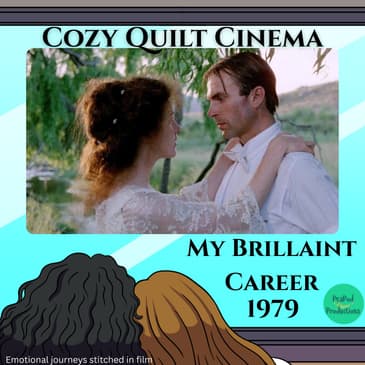
Beth and Michelle revisit My Brilliant Career (1979), Gillian Armstrong’s Australian period drama starring Judy Davis and Sam Neill. Sybylla Melvyn is a headstrong aspiring writer surrounded by people who believe marriage is the only sensible future for a young woman. Then she meets the charming Harry Beecham and discovers that choosing freedom becomes much harder when the life she is refusing includes someone she may genuinely love.
This week, we discuss the film’s beautiful, almost painterly landscapes, its deliberately slow pacing, one unexpectedly complete pillow fight, and the maddening chorus of women and men telling Sybylla to accept her proper place. Harry may support her ambitions, but she would still need his permission to pursue them, and Sybylla would rather face loneliness and uncertainty than surrender ownership of her own life. We also pay tribute to Sam Neill by returning to the first leading role that helped introduce his warmth, humor, and unmistakable presence to the world.
In the Stitch Count, My Brilliant Career earns 6 out of 9. It easily passes the Castellini portion and avoids a sexualizing camera gaze, while Sybylla ultimately retains her agency and chooses her creative future. Its overwhelmingly white world and lack of meaningful LGBTQ or disability representation hold it back, but its feminist purpose remains remarkably clear: she can love Harry and still choose herself.
[00:00:00] I have never had a pillow fight that came to any form of completion, okay? Welcome back all you ladies and mates. It's time for another episode of Cozy Quilt Cinema. I'm Michelle.
[00:00:27] And I'm Beth, currently turning down a perfectly good marriage proposal because I've got a novel to write and absolutely no time for a comfortable, predictable life. Every week Michelle and I curl up on the couch and watch a movie and just talk it out. How it makes us laugh or cry or sit on the edge of our seats, even lean into a loved one. So grab your Mimaw Stubbornest Quilt, get in the
[00:00:50] blanket fort and let's talk about it. So this week we're talking about My Brilliant Career from 1979. Yeah that's right. Before we get into the program we want to say that because most of you probably already know by now that Sam Neill passed away this week at 78, surrounded by a family in Sydney.
[00:01:16] He was very beloved by many, many people and as much as us, meaning myself and Beth, enjoy his movies and seem to, he just radiates like this, I'm a really cool guy. From what I've been reading, he really was. He was very sweet. And the director of the movie that we are going over today,
[00:01:45] Jillian Armstrong, she wrote a little, well she wrote a pretty long goodbye to him in The Guardian, which I'd like to like pick out some excerpts. So she starts out by saying, what can I say? I'm shocked and sad. He'd just been through cancer treatments and was finally free. And bang, he's gone. But what wonderful heartfelt tributes from everywhere. Yes, Sam was a great actor in so
[00:02:13] many films, so many roles. Dashing, dry, evil, cheeky, damaged, and very heroic. Even my grandson knows that man with the dinosaurs. I loved him having fun as that sly, handsome, gray-haired lawyer in the 12. Our real Sam was a little shy and a smart, gentle, decent, passionate, loyal, surprisingly
[00:02:36] funny man. Maybe not the best YouTube singer or pig-namer. She goes on to talk about how Steven Spielberg and Roger Donaldson, Graham Baker, and Philip Noyce and herself were all thanked, I'm sorry, by, they were thanked by Steven Spielberg for first casting Sam and knowing him and showing him
[00:02:57] off to the world. She goes on to talk about how young they were when they met. And she says, we were all so young and naive. It was obvious from day one that the cameras just loved him. And I still love him in our film, especially the pillow fight that he and Judy improvised in rehearsals so well that it made it longer. And the pillow fight's not even in the book. Yeah.
[00:03:24] Um, again, she goes on how about eight years ago they re-watched the film together to just, and he was just like, I was such a child. Um, again, it's a very, very long article of her saying goodbye to him. But she says, the day before he died, I came across the rerun of his episode of the
[00:03:49] assembly. When he was interviewed by autistic students, one of them asked, what have you learned from your parents? Sam paused for a very long time and teared up, then tried to be kind about his parents' lives. I teared up too. I could also see little Nigel, his given birth name, standing alone on the train platform on his way to boarding school. I can't believe that the very next day he was gone.
[00:04:14] Now I'm really tearing up. He will be missed in so many ways by so many people. Best wishes and love to all of his family. We finally cracked open the 1998 Neil Pinot Noir last night and made a toast. Thank you for being our Harry and our Sam. I like that. Yes. It was very, very sweet. And again, she does talk about a lot more. I can't get into it without
[00:04:41] being a complete sobbing mess right now. But it's so nice to see that even regardless of the characters he plays, the person that he projects onto the world is as nice and as kind as we see. He's actually that person. And that's always refreshing. Because I hate when I find out that somebody I like that's famous is a real dick.
[00:05:09] That's true. Well, you know, I was asked by a couple of people why I picked this film. And it really is because I knew a lot of people wouldn't. Oh, no. Yeah. Everyone's going to do Jurassic Parks and they're going to do... And that is great. I think that, you know, his body of work, it should be celebrated. The things we love should be the things that highlight to you. I was actually... If you hadn't come up with this, I was going to say, I think we take the
[00:05:37] whole weekend and watch Merlin. It's a mini series. So it's very long. I almost suggested that to you. But I'm half afraid to watch the movie. No, he's a good Merlin. The show. No, it's not that. It's not like that. But it definitely goes into like the Morgana thing very, very deeply. It was good. He's not my go-to Merlin, unfortunately. It is Colin.
[00:06:01] But I do love him as Merlin. It worked for me. I'm picky. Yeah. And it feels strange right now that we're going to record this episode about, you know, the movie that made him a star. Oh, yeah. And I love how it's called My Brilliant Career, even though it really has nothing to do with him or his character. It really doesn't. But what it does have to do with is this was kind of his big break. Okay. That's nothing but noise.
[00:06:31] I did not expect that. I'm sorry. Yeah, I was saying, you know, how it feels strange to record an episode about a movie that made him a star. You know, and it's just like so recently after losing him. It's only been a few days. Yeah. And this was his first leading role. So it's the whole point of my choice is because this is not what catapulted him. This is what gave him the direction.
[00:07:00] It's the one that got him noticed, really, by a lot of different people. Yeah. I mean, it aimed him in a trajectory. And I think he had a great life. Oh, yeah. I think, you know, despite anything he may have experienced as a child. Yep. He made a great life.
[00:07:20] And again, he didn't take that pain that obviously he had, which again, I would, you know, I don't want to delve too deeply into that part of it because he healed. You know, the pain never goes away when we're hurt by these things. But he's, you know, he touched a lot of people and he made a difference in a lot of people's lives.
[00:07:50] Well, I looked through a lot of things about Sam because, you know, we're doing this episode and, you know, I'll go down any rabbit hole. Yeah. But over and over again, it was people remarking on how warm he was, how patient he was, and how genuinely kind he was. Like when he walks into a room, like even in this film, you could see like a kind of space that's around him, like a kind of denseness of air. I don't want
[00:08:19] to get too ethereal here, but he has a presence when he walks in and you feel that weight as it enters the room. Well, what's funny is in this film, when she is sitting up in the tree and he enters the screen for the first time, because like, it's a bit before he appears into the film. Oh yeah, I know, it's way in. He comes on, he's on a horse and you know it's him. You know, it's him even though, like
[00:08:49] I've never seen this before. So I had no idea when he was introduced into the story. I had an idea of who his character was because of my research over like just, you know, my basic information. But I didn't know anything else beyond that. If he was one of the rich people or if he was one of the poor people. And so when he comes in on that horse, there's just his whole physique. There's something about it. And you know, that's Sam Neill.
[00:09:19] Oh yeah. It's oddly enough, like Jeff Goldblum entering a room. You know it's him. They both have energies and, but both of them are vastly different energies. Oh my God. One of them is bipolar, definitely. And the other one is very sedate. So definitely. So it was definitely a thing that you could, yeah, we keep saying definitely. Definitely. It's like that thing we, there's a, anybody who has two cats always has the same
[00:09:44] two cats. One is a loving, fluffy, little fairy who can never do anything wrong. And the other one is a maniac, crazy person who's wanted in all 50 states plus Guam. You know, it's like, you know, everybody has those two and that's Sam Neill and Jeff Goldblum. They are the two cats. That's true. Well, let's talk about what the film actually is since I never gave. No, because there's more information about this movie too. And that's another whole story too. Yeah.
[00:10:14] Let's get into that. So, God, we're just all over the place like a shotgun. And I'll feel horrible about it, but my brilliant career from 1979 is, it's the 1890s in rural New South Wales, Australia. That's a lot. That's, that's where we are. That's where we are. Is it syllabilla? Sabella. Sabella. I just don't like the way that's spelled at all.
[00:10:41] I know, I know. It's too many whys, but that's what they, I think that's what they were calling her, Sabella. He was calling her Sib, and then I think somebody called her Sibby, but it was, yeah, it's Sabella. Yeah, I kept shorning it in my head. Yeah. So, Melvin is a headstrong, creative teenager stuck on her family's failing farm, dreaming of becoming a writer instead of a wife. When money troubles send her to live with her wealthy grandmother, she's polished up, sent
[00:11:11] out into society, and courted by a handsome young landowner named Harry Beecham. The whole movie hinges on one question. Does she choose the safety and love of marriage, or the uncertain, lonely, thrilling road of an independent, creative life? And that is the description. Yes. How did this movie make you feel? The first time? Mm-hmm. You were little. Because we've both seen it.
[00:11:40] No, I didn't. I thought you saw it. No, I've never seen this movie. Are you sure? Yeah, I said I didn't see it. I've never seen it before. Because you told me earlier that you saw it in the background. No, no, I never did. You told me you were in the background. I know. That's why I thought that was particular. Oh, no. Or peculiar. No, I've never seen it in the background. Okay. Nope. I guess I'm wrong. So, I'll just move on. It's okay. I mean, it's... I could have sworn you told me you'd seen it, too, and that's why I was talking to you
[00:12:10] like you had seen it. No, no. You didn't pick that up at all? You even asked me, like, two days ago, have you ever seen this movie? And I said, no. No, but when we talked earlier, you said, oh, yeah, maybe I have seen this. No, no. I think we were talking about something else. I don't remember now, but I've never seen this movie now. Okay. That's fine. We were talking about the movie, but that's okay. Well, again, all day today, we've been talking about two different things and misinterpreting. I know. It is fine.
[00:12:39] My feelings on this movie are frustrated because you hadn't seen it. I have not seen it. You told me. I mean, my feelings on the movie were I was bored the first time and the second time, but that's not really the issue. I'm fine with being bored by something. Yeah. It's not that there was any bad dialogue. It's not a bad movie. Actually, I know what it was. It was too little dialogue. Yeah.
[00:13:08] A lot of the scenes were just the scene. Yes. Just beautiful. Beautiful composition in the scenes. I was telling you, they kept positioning themselves as if it was an oil painting. Yeah. Her sitting under the tree with the fence on the bottom and the stream and the cows in the background. Him reaching out with the flowers was a perfect oil painting. And it was framed by the fence. Yep. It was beautiful.
[00:13:37] I know we're talking about the movie, not my feelings, but I was bored, but I was also very engaged, not in so much what they were doing as I was engaged in the scenery. That, and I really, I mean, as much as I wasn't engaged in what was happening per se, I did want that happy ending. Oh, of course I did. I was waiting for that moment for it to be like, oh, you know, he's just going to play. She got it. Yeah. She definitely got it. You know?
[00:14:06] Well, I mean, it was her, the ending, her great ending. Yes. It was. It was a slow burn, just like everything else in this movie. Mm-hmm. I keep wanting to say show. I've been watching Monk too much. I know. We have been re-watching Monk. Way too much Monk. And that becomes an issue. Yes.
[00:14:26] So I also had issues with my attention span, as per usual, because I have no attention span and I cannot unless I'm doing like 13 different things. God, I feel like my ADHD has definitely gotten worse as I've gotten older. And it hasn't gotten better. It has not gotten better. I've learned how to handle certain things and to get myself through certain things. But then other things, I feel like I'm failing immensely.
[00:14:56] But regardless, it was a beautiful film. And would I put this on my favorites list? Yes. Would I put this on my re-watch list? Most likely no. Unless it came on in the middle of the night and I needed something calm to watch as I was drifting. Okay. But okay. First of all, let me... I say it's not first of all. We've already done a first of all. Let's do another thing. Let's talk about real quick the director and the writer. Yes.
[00:15:26] Well, yeah. I was going to get to that in a minute. I know. But I rushed us right into talking about the movie. And I rushed us into feelings. So there we go. There we go. So Jillian Armstrong is the director. Yes. And this was her feature debut. Made at just 29 years old. She also did Mrs. Selfal, Little Women, and Oscar and Lucinda. So the Little Women version is the one with Winona Ryder and Susan Sarandon in 1994.
[00:15:57] Okay. Yes. I wanted to specify because there's been many versions of Little Women. Yeah. And that is my personal favorite version. I mean, there's a lot of versions. And also... I mean, quite a few. Little Women, I cannot sit through either. I love it. Don't get me wrong. But I cannot sit through it. It's very hard. And I would do it for the podcast, but not for my own entertainment. That is perfectly understandable. There are certainly movies everybody has that they enjoyed.
[00:16:26] But they can't bring themselves to rewatch it. It's something... Well, I know it all now. This is what I know, and I don't need any more of it. And it's funny. So I know we rewatch TV shows all the time. If you didn't rewatch them, I probably would not. Because once upon a time, I rewatched television shows. And now I have a hard time independently doing so. Yeah. No, I get that. And I guess that's another one of my mental inabilities.
[00:16:56] Well, the writers. Yes. Miles Franklin, author of the original 1901 novel. 1901. Right. Written when she was only 16 years old. Mm-hmm. She's also known for... I didn't know there was a sequel. Oh, I didn't know there was a sequel either. My career goes bung. It's a 1946 sequel novel. Oh, wow.
[00:17:23] Old Blastus of Bandicoot, 1931. And All That Swagger, 1936. You know, the Australian mind is a crazy, crazy thing. But this is semi-autobiographical, because I can say big words, people. And she was cool, because yeah, like I said, she was 16 when she wrote it, but it didn't get published.
[00:17:45] But due to some issues with literary controversy and family upset, she made sure that it was not republished again until 10 years after her death. There was a republishing in... Now, she passed away in 54. In about 1965, there was a resurgence of popularity in this novel as it was then republished and
[00:18:12] open to a whole generation that had no idea about it. So that was... Great idea. Yeah. That's brilliant. Yeah. And it kind of made sure that the people who were upset by it and who were having issues with it, due to the 1901 mind frame, you know, they were long gone when it would be republished again. And she could not, you know, wouldn't have to worry about them clutching their pearls. True. Eleanor Whitcomb.
[00:18:43] Eleanor Whitcomb. Yeah. She did the screenplay. Yes. She was a screenwriter, adapted it from the novel. Mm-hmm. And she also did Caddy, 1976, The Getting of Wisdom, 1977, and The Irishman, 1978. Yes. Sad to say that out of the three main actors and these three women who we mentioned just
[00:19:08] now, only Jillian and Judy are still with us now. Yeah. Yeah. That is always the difficulty with an older film. Mm-hmm. And this isn't that old for us. But it is quite old. It is. Most of these people were well into their, you know, 30s and 40s when these were being made, if not older. And now they'd be 80s to 100. You know, it's kind of crazy.
[00:19:38] Well, to me, it really kind of got me too, is that, so Judy Davis, the actress who plays Sabella Melvin, she is the same age as my mother. Yeah. So looking at her in 1979 film going, damn, I was five. My mom was a baby. Yeah. I mean, I was a baby when I had my baby, but that's, you know, it's weird. I don't know any of the films she's done outside of this. Okay.
[00:20:08] So she was in the movie Marie Antoinette. That was one of my favorites. That's, it's the Marie Antoinette with Kirsten Dunst. She was, she played Nancy Reagan. The newer one. Nice. She played Nancy Reagan in the Reagans and she was in Naked Lunch back in the day. Okay. I would like to do Naked Lunch. That one's a fucked up movie. I have some other ones. Okay. A Passage to India. Okay. Yep.
[00:20:33] Barton Fink, 1991 and Husbands and Wives, 1992. Yep. So she's done a lot. She's, yeah, yeah. She's been around. She's one of those actors that you know her when you see her, but you can't picture her. We have, I mean, that happens a lot. She would make a perfect spy. Very much so. Because she makes an impression until she leaves the room. She was in Nurse Ratched. She was in the TV show. Yeah.
[00:21:01] But I can't picture her. Like, I can't even picture her in any of these films. That's what I'm saying. Other than Nancy Reagan because Nancy Reagan looks like Nancy Reagan. It's the James Bourne thing. Now, I know in the movies they have a different thing, but in the books, James Bourne has a forgettable face. He's, he can't speak another language. No. Because he's not good at other languages. He's terrible at them. Mm-hmm. So in the book version, he's the imperfect version of the superhero spy.
[00:21:31] Yeah. But he had, in the books, he had a forgettable face and so does Judy Davis. It's crazy. And it's not in a bad way. I mean, honestly, I think I loved her freckles in this. Oh, I did too. I think they were cute. I like the ones in the lips. In the lips. I was going to say she has these freckles in her lips. I loved. But, yeah, I mean, I think that she is pretty spectacular, especially because when she enters a room, she always draws you to her. Oh, definitely.
[00:21:55] And it's not, and I know in the movie it's fucking horrible that they do the, it's just the most misogyny I've ever seen encapsulated in one area by the women who are being suppressed by it. Yes. I know I'm getting very, this is patriarchy, but it is. No, but that's what the movie's about too. Sure. It's a very feminist story, regardless of whether you're reading the book version or you're doing, watching the movie.
[00:22:20] It is still a very feminist forward movie for the time period, even the time period it is portraying. I spend a lot, I spend a lot of time of this movie being equally bored. And outraged. Outraged. At the misogyny. I was bored by the pacing of the misogyny. You will marry me because you have no other choice. No, it's the most infuriating is the women. Oh, I know.
[00:22:49] Who don't just acknowledge that this is a horrible system. They acknowledge that and then they tell her, eh, what you gonna do? Basically, they're saying you're kind of fucked. This is it. This is the way it is. It's your lot in life. It's not a lot, but it's life. There you go. Exactly. God, this is terrible. I'm so sorry, Sam. I know, Sam. No, I think you would appreciate it because we're not tearing it apart. We're not really. No, I'm not. I mean, we are, but we aren't.
[00:23:18] I'm not tearing it apart. I'm acknowledging the fact that this is probably the most feminist forward film I've ever seen while still being entirely misogyny. Oh, no, hell. And that's it because you have this heroine and that's really what she is, even though she's her own hero. She's nobody else's hero but herself. And that's okay, too. Because she's not being a role model for other women. She's not trying to change women and having this little army of, you know, fems behind
[00:23:46] her going, oh, we're gonna not do the dishes anymore and clean your mud. And I mean, we're not gonna do this anymore. She's doing it only for herself. And that's okay. Because sometimes you have to be your own hero. Everyone keeps telling her to stop being selfish. Yeah. And I'm like, no, girlfriend, they're not letting you think about yourself. Be selfish. Because nobody else is gonna take care of you in that shit world that you live in right now. Because what choice does she have?
[00:24:14] Literal shit farmer or somebody's doll? Yeah. Or forced into servitude. Oh, yeah. Or forced into servitude. Or enslaved. Yeah. Yeah. So it's in the whiplash of back and forth that she has to go through when it comes to slow motion whiplash. But she goes from her world and her parents' farm to this upper crust world, back to the dirt.
[00:24:43] No, worse than her parents. Oh, worse than her parents. Oh, so much worse. And then, you know, going back to her parents, and it's like, what? And her sister. It is difficult. It is very difficult. Oh, yeah. To deal with. There's the boredom is the pacing, not the people. No, no, no. The people are very colorful and like Uncle Julius. You kind of love him. I kind of love him, yeah.
[00:25:13] Because he's a rascal. Even with his mouth kissing. I know, but he's a rascal. He really is. But he's good-hearted because you can see he does that kind of thing, and I really wanted to like put it towards that. In a movie we've done before, which is While You Were Sleeping. Mm-hmm. Oh, yes, yes. The uncle. The uncle. He's kind of that kind of person who is going to prod the matron of the house to do the right thing. Yeah. Yeah.
[00:25:42] Despite the fact that he doesn't really have a stake in this. True. He just knows he loves, you know, people, and he's a good person. Yeah. And I kind of love that he is kind of making these little comments that throughout the movie are that nod to. Well, I like when they find out that she has to go back. Well, she's going to get traded because her parents owe money, so she's going to go and
[00:26:08] be a nursemaid, basically a teacher of sorts to this- Full-time babysitter. Full-time babysitter to this family of 15 billion children ages two to whatever. And he's like, oh, and she's upset about it, obviously. And he's like- Ages two to 47. I mean, basically. And then, you know, and the uncle, he's like, oh, it's going to be so boring around here without her.
[00:26:36] Because he knows she was bringing life into this. Well, he even brought it up. She should be an actress. Mm-hmm. Because she was dramatic, and she didn't know what she wanted to do, but she knew she wanted to do something good and something important to herself. She's like, ah, I might play piano. I might write. I might be an opera singer. I don't know. Okay. So this is a great setup for the issue that I had, not with the movie, but with myself. Mm-hmm. Because I was doing that exact thing.
[00:27:05] I was watching the movie, and I was indignant for her. Yeah. But at the same time, I was also kind of rooting against her. It was kind of a weird thing. Oh, because of her. Because she does get a bit arrogant about things. It's not the arrogance so much as the situation she sets herself up for. She has no idea what she wants to do. Mm-hmm. If she'd had a direction, maybe anybody could have gone, well, maybe we should just fund that and see what happens. Yeah. But she didn't offer any of that.
[00:27:34] She had nothing prepared. And I am kind of like, well, you know, you don't have any direction. I'm giving that criticism. At the same time, I'm mad at myself for doing that because the whole point of this is she shouldn't have to have any aim. Not at all. She shouldn't have to have a goal or some reason not to marry her off. Mm-hmm. It shouldn't be a thing of marrying someone off.
[00:28:01] And that's what this movie is kind of really comes home to is she doesn't want to get married. And they keep trying to do this. Mm-hmm. And it doesn't matter that she fell in love with Harry. It doesn't matter because she doesn't want to get married. So it has nothing to do with love. It is separate in a way for her. My heart breaks for him, though, when he's like, but don't you love me even just a little bit? And she's like, I'm almost in love with you. I'm almost there.
[00:28:30] I think she's as much as in love with someone as she can get because she's just not going to allow herself to be. And that's okay, too. And again, I've said this so many times on this podcast, an adult's brain isn't fully developed until they are 25 years old. We should not be forcing individuals between the ages of whatever, 16 and whenever to know
[00:28:58] who and what they want to be. I mean, some people in their 40s don't know. I didn't know. I'm still not even sure what I want to be. And I'm pretty set in a career, and yet I still don't know if this is what I want to do for the rest of my life. I love working with little kids, but I'm tired and I hurt because I'm old. So I have to think about these things, and I have to constantly be willing to change.
[00:29:25] And we should never force young people to pick. And we do. We have done it for generations, and we will continue to do it for more generations because we're idiots. And we do not learn. And this is part of why we have a whole generation upon generation upon generation of children who don't know who they are because we're not letting them. It was okay when it was, you know, when it was a silent generation.
[00:29:53] And even then, it was not okay. But it was accepted as you either found your way or you didn't. And if you didn't, you had to work, work, work, work, work, work, work. Or get married. If you went to college, you were going to college to get married. And that followed through into the boomers. Well, yeah. And now we're back in the purity culture. Of going to college to meet a husband. Yeah. And, you know. And that's not.
[00:30:21] You know, well, of course, it's a lot more expensive to go dating that way than it is to just get, you know, a dating account, you know, an app on your phone. Because, you know, who can afford college? I sure as shit can't. But in this movie, they create the very culture that, I don't know, forces the marriage. Mm-hmm. Because they use the culture itself as the issue. Yes.
[00:30:50] You know, that's where it's broken. And being forced into marriage as basically property kind of. Mm-hmm. And we're not talking about the Australian culture. We're talking about the. I'm talking about the patriarchal. The patriarchal culture of that time. Not the. I don't know anything about the culture. Oh, no. Because honestly, they, this, this. In 1901, these were still British people who were transplanted. Yeah.
[00:31:18] You know, the, at least the, those upper crust ones mostly were. I mean, because the one dude, he's like, I'm going back to England. So, and I want you to come with me. But it's that same kind of like, you know, it's definitely male centric and it doesn't matter what women want. No. And it's just the entire movie is people telling her just to swallow it. My, there's a quote. I wrote it down because honestly, it hit me in the face.
[00:31:46] And I even commented out loud on this one too, but it was the aunt who says loneliness is a terrible price for independence. Oh, yeah. It's gaslighting at its finest by your own people. No, loneliness is not a terrible price to pay. Some people are by themselves and are genuinely happy. But it doesn't require loneliness to be so. Exactly. You can, you can be married.
[00:32:16] All you need is equity. That's all you need. If you have equity within your partner, whether it's a guy or girl or whatever, then yeah, you don't have to worry about that because you are equal and you do not have to be the sub, the servant or the mother for this person. But like, if you don't want to have somebody in your life, if you are happy living with your pet or by yourself because you can't have pets, you know, bless you.
[00:32:46] And if you're not, then, you know, you do you. It's okay. None of your feelings are invalid. And that's what bothered me. I spend so much time telling these little kids that their feelings are valid. And then to hear a statement like that, which it's like, God, the mental health that we were so unaware of back then. It's amazing how we're all still alive at all.
[00:33:14] Well, I mean, one of the first things I wrote when we were watching this film is this is a lot of gaslighting of women into believing that thinking and speaking out is wrongheaded. Mm hmm. It is just everybody she meets basically tells her that you can't talk that way or you can't be that way and you cannot feel that way.
[00:33:42] And the only people that really haven't done that is Harry. Oh, yeah. And sorry. And his mother. Right. Yeah. Yeah. I believe. I believe. I think it's his aunt. It's his aunt. Yes. Um, so those are the only two. I mean, she, she really got along with her. Yes. And I think at like when she goes to live on the dirt farm, because that's really all it was was to me was a dirt farm. Everybody was dirty and money. They were farming dirt. I mean, pretty much.
[00:34:12] And. It's the evaporation stations in Star Wars out there in the back. No, he reminded me of the scene in Monty Python and the Holy Grail when he's talking to the farmers about I didn't vote you in, you know, like that one. And they're sitting there just moving the mud from pile to pile. And that's what I kept thinking of. And she's trying to teach these little shit monster children. Oh my God. And that's what they were because they were just sitting there smirking at her while she's writing on that board because they can't read.
[00:34:41] And then they're like, they, something come running through the little schoolhouse shed. And. I think it was a rat. Yeah. And they all ran. And she's like, get your, you know, get back here. And they're like gone. And then later on, she's doing, she's trying to teach them yet again. There's no, there's no textbooks. There's no nothing. There's just her, her father's, what was the, the kid said, dad says you can teach us from your brain. And so.
[00:35:10] Because the books got eaten by mice. Yeah. Or something like that. And so, you know, in the, one of the kids like throws, he has a little slingshot and he, he shoots her in the face with something. I don't know if it was a spitball or something. A spitball or gum or something. I don't know, but she gets a switch and she is wailing on his ass and his, and he's screaming and his mother comes running out and then she stops and sees what she's doing
[00:35:36] and she's still hitting him in the behind and staring mom down and mom is staring back and you can see mom's lips kind of twitch a little bit. And then she's like, you know what? Shit. I've never been able to get him to listen. I'm out of here. And she walks away. And after that, you see them all standing around the piano days later, all singing and the kids are listening. She's reading them. They've got newspaper on our paper book pages on a wall and she's reading. Well, and they're getting into it. Oh yeah. Kind of made it into a game.
[00:36:06] Try to find the page. And that's one thing is this family isn't a bad family. No, they're not. They're actually really nice. Once you get to that point. In fact, they're so nice. They forgive the money because they didn't want impropriety. So she goes out at night to think. Right. And she finds out that her sister is now. Well, she's being informed, which is not true. Yes.
[00:36:32] That her sister is going to marry Harry. And so she's upset about this and she goes out, but she sees the older son and the older son has been going, sneaking out. And that was Frank Hodden. Yeah. That's Frank who was actually going to marry her sister. And that's played by Robert Grubb. Aha. Yeah. And so she, so the mother and the father, they're like, well, you know, we understand he's a good looking boy.
[00:37:04] Ew, he's a boy. I mean, he's a boy. But they're like, but we can't, you know, we can't keep him. We don't have any money. You don't have any money. You don't have any property. Or you don't have any money. I mean, you don't have dowry for us. Oh, dowry. Don't even get me started on dowries. But yeah. So she's like, I'm not. Okay. And they're like, okay, well, we'll have to send you back to your family.
[00:37:30] But we'll, and we'll call it, we'll just call it even for now until your farm starts doing better. We're going to get our money, but we'll wait for it. And this is like the third time she's had to move. Yes. So she goes back to her family at that point. And, you know, she's trying to find that happiness.
[00:37:52] She knows her mother left that upper crust family to marry for love, not for society and propriety. And so she doesn't want either of that. She doesn't want to marry for love. And she doesn't want to marry because she's, you know, just because it's what she's supposed to do. She wants to find out who she is. Well, yeah. There's love or financial, you know, position.
[00:38:21] And she didn't want either one of those things. That's, that is something that's perfectly understandable, or at least should be to most people. But the thing is, she chose the third option that her mother didn't give her. And that, and it's in her mother's who said to her that Gertrude, she's like, well, at least one of my daughters is going to marry well. She's going to, she's going to marry Harry. And it, that, of course, you know, again, that was the upsetting part for her, but it turned out it wasn't true.
[00:38:50] But she, she had turned down Harry early on before she went to the mud farm and. She didn't turn him down. No. She said, I can't do it right now, but if you can wait two years. Yes. I will marry you. And he didn't wait two years. No. But he still came back when she was back with her family's farm. And asked her again.
[00:39:17] Because he heard she was returning. Mm-hmm. He thought that meant he was returning to her. But she's just been pushed around by, I mean, he should know that she doesn't, she doesn't get a choice on where she travels. She's being told where to go. And this way, you know, and she, and he asks her again, and she turns him down again. But she says, not, I mean, she's again, not really turning him down, but she's still saying, give me time.
[00:39:47] I need time. Yeah. She goes, I want to be a writer. So I'd like to believe that he does give her time. And he comes back. And, you know, he does say that there's still going to be friends. There's still going to be mates. You know, and he, and regardless of it all. And that's really, honestly, a good thing. But you know who I picture they could be a version of? And it's another movie we've done.
[00:40:15] Sister Husband from the Walmart movie. I keep saying that. The Walmart movie. Where the Heart Is. Oh, oh, oh yeah. Sister Brother. Oh no, Sister Husband. Sister Husband. You're right. Sister Husband. Oh yeah. Oh wow. They were hooking up. Right. But they were, they were not married, but they were, they were basically husband and wife. They were family. They were. Yeah. And he took care of her even after.
[00:40:45] So I think they very well, Sam, sorry, Sam. Harry. Harry. I hate that. I know. So Harry and Sib, I could see them. And of course we don't know because there obviously is a sequel I didn't know about. I know. And now I don't want to know about it because I like my memory, my headcanon. But here's the thing, now we have strong feelings about a film we didn't really think we would care about. No, I really didn't.
[00:41:14] And I was actually, I mean, again, this was one of those cases where I was just like, I don't want to watch this movie. I know. Nothing against Sam Neill. I just wasn't prepared and I didn't know anything about it. But actually, as I was reading little bits about it, I was going, okay, I kind of want to see this movie now that we're going to watch it. And yes, it's hard to get through some of the parts because it is slow. It's not, again, it's not bad. I hate when I say that it's one thing, but it's not.
[00:41:43] It's not a bad movie. It is an excellent movie. It is a fantastic movie for a snapshot of a time period. But it is hard. Yeah, but in terms of time, it's the balloon pants of movies. Oh my Lord, it's done. It's just hard. It's so, because it's got a lot of quiet. It takes a lot of time. It does. It's an hour and 40 minutes, but it does not feel like that. It feels like three years.
[00:42:09] But I liken it as a souffle. It could not be rushed. No, no, no, no, no. I think if this was rushed, it would certainly not have any depth to the points where they start talking again. And that silence, I don't think it's there just to take up airtime. I think a lot of it is just in the scenery, which you have to have a sense of.
[00:42:36] Because everywhere she goes is something very scenic, but it's also starkly different. Oh gosh, yes. It's so... And even when I keep saying about the mud farm, there are still beauty. The beauty in these scenes are, again, everything is framed as a snapshot or a painting. It is... Even the farm, it looks like something straight out of America's Dust Bowl.
[00:43:05] Even though it's mud, it's still got that dirt. It is like being in a museum because when you hit those moments, it's almost surreal. And you're looking at it going, okay, yeah, I get a sense of this place. And what's funny is so like her family's farm, it was just dusty and dirty. And they literally were having a dust storm with all the windows open. They're trying to get her to close the windows. And they're all preparing.
[00:43:32] And she's just in her head, writing away. Well, yeah, she's writing. Then she walks outside. I walks outside. I'm like, your dirt is getting in the house. But then, and all I could think of is when I lived in West Texas, everything is dirty. Yeah. Everything is dirty. Everything has a grittiness to it. And I always hated that. It's like living on sandpaper. Oh, my God. And then when she goes to the... I don't remember where... Is it Sydney was where the families were?
[00:44:02] The richer ones? Yeah. Okay. Pretty sure, yeah. Everything's lush and green. Oh, yes. Beautiful. Beautiful. Beautiful. And just, I love that lush greenness. We've been watching a YouTube husband and wife who are rebuilding a... Dunham Manor? No, not Dunham. Yeah, Dunkum. Dunkum? Yeah, because you know why? It sounds like bunkum. Oh, yeah, that's right. It does. That's why I remember it.
[00:44:32] So it's Dunkum Manor. And they are behind their manor. It's an old abandoned manor that they bought and are renovating. It's Dunkum House. Dunkum House. That's it. And I'll post the link to their channel, to their YouTube. And I'll send you the link... It's very interesting. ...to post for the Guardian article. And it's really reminiscent of the time that we're talking about. It really is. They're not in the same area.
[00:44:57] But behind their house are these farms from, you know, people who actually work the land back there. They don't own that part. And it's these wheat fields. And it rolls when the wind... Like the ocean. It's just beautiful. And that just... That makes me so happy. I love that lush green. But that is kind of the framing that we're talking about in the movie. Everything is the most idyllic version of itself.
[00:45:21] Like you don't know what a place is like until you see an oil painting of it. And then you feel like you've been transported there. Yes. And then when you see the real thing, it probably isn't as exciting. That's how I get this movie. Well, yeah. Like you get the scene, okay? Like that perfect scene. Mm-hmm. And then the film transitions you into reality. Yeah.
[00:45:46] Her reality, which is that idyllic version of the dirt farm becomes the actual dirt that she's in. Yeah. And then that one piece where it's got the railing and she's at the tree. Mm-hmm. And he's handing her the flower is a perfect snapshot of a douchebag she doesn't care about. Oh, yeah. She throws the flower straight into the water. Right. She doesn't care about him. And then she does the cutest thing. It starts raining.
[00:46:15] And she starts dancing in the rain. And that's because she's lived in this dust bowl. And so this is the first rain she's seen in a couple years. She even said that when she goes back in the house. And she's obviously got a cold now. And the grandmother is like, well, this is why we have to maintain propriety. And we shouldn't be dancing in the rain. And da-da-da. And she's like, but I haven't seen rain in two years. And grandma's got a little bit of a smirk because she kind of gets it.
[00:46:43] But she also knows that that's not accepted in their society. She is a little bit more forgiving than her mother. Her mother, yeah. Yeah. But not a lot more. Obviously, she has to be because her mother left home for her. You know, she went to go. She chose that farm lifestyle because she chose that man and knew what she was getting into. Breaking away. So, really.
[00:47:11] Yeah, but she's perfectly willing to, you know, she didn't give up everything because she's going to use her daughter as a commodity. Well, yeah, yeah. You know, so they'll keep living on this subsistence kind of farming and fail and have to keep borrowing money. And they just keep finding new ways to use her to do it or the other children. Yeah, and I love how she's like, I don't want to be a married woman who has to have a child every year.
[00:47:41] And that's my lot in life. And because that's what she sees. Her mother has babies every year. Like when it pans through the house, like when they're all sitting inside and she's playing that untuned piano. And you could tell it's driving everybody nauseous. I mean, they're like, oh, my God. And you're panning through all the children. And you can see the various ages, and that's her mother's children. And you see the same thing at the other farm when she's there to be the school mom, whatever.
[00:48:11] And... The mud farm. The mud farm. I'm just trying to not say that again. But you can see the different ages of the children again. And they're literally a year, like pretty much a year apart. And that first thing, pregnancy takes a lot out of a woman. I cannot imagine these poor women who have babies like that willingly, let alone the ones who have no choice,
[00:48:42] how much it must age their bodies, hurt them. Um, I had a student last year who was the last, and she was five, and she was the last of 10 children. Now, granted, her mama looked great. Don't get me wrong. She looked great. But even then, I didn't, I didn't have any clue. But this was a choice. Yeah.
[00:49:07] But the ones who have no choice, I can't imagine the toil and the strain. Oh, no, that would be horrifying. I had three children, and I'm practically falling apart. That has to be the most frightening thing to even think about then. Oh, my gosh. And the women who get pregnant later in life, I, bless you women, bless you ladies, because honest to God,
[00:49:27] if I was pregnant now, oh, God, no, no, I can't even, I can't laugh and sneeze without pissing myself now. You put a baby in there? God damn. I wouldn't move from a seat, and I'd be wearing diapers of my own. Speaking of which, let's talk about the pillow fight. Oh, my Lord, the pillow fight. See that transition? I know. Oh.
[00:49:54] So, Seb drops a pillow out of the, well, it's at her, as Harry's aunt's. Yes. At Harry's aunt's place, she's staying there, and she's upstairs, and a pillow drops onto Harry's head. I don't know if it dropped or she did that on purpose. Well, I mean, she did throw it at him. Yeah. Just, you see it drop onto his head. He's on the porch, yeah.
[00:50:18] Yeah, and he looks up, and he grabs the pillow, and then she starts running away with a pillow in her own hand. Yeah, and he goes up the stairs, and she comes around the corner and whaps him right in the face. This is the most vicious pillow fight. Three-minute pillow fight. It is, I mean, it's maybe not as vicious as some YouTube pillow fights. I'm talking about between two consenting adults who aren't trying to kill each other. They smack each other in the face quite a bit. Oh, yeah. Oh, yeah.
[00:50:48] And I think those feathers have to be extra heavy feathers, because they're literally knocking them down. And that pillow fight was something that Judy and Sam were doing off-screen, and it became like a thing, and they decided to throw it in the movie, and it became this extended version of the pillow fight. And while some places were claiming it to be a very erotic scene, I didn't take it as erotic,
[00:51:16] but I did see it as a very sweet moment, a very playful moment. And then when they fall to the ground, that's when you see the full chemistry between them. Yeah, but I feel... But it's still not erotic. I know. I feel like I'm missing something when someone thinks, when that many people think this is an erotic scene. Yeah, but I think that there's a lot of people who think that Fifty Shades of Grey is erotic, and that's just abuse. So there you go. That's true.
[00:51:44] So, but yeah, I think the pillow fight itself is... It's not really the fighting, and I don't think it's about eroticism. I think it's really about showing her that there is someone who... Meets her energy. Doesn't care. Yeah, doesn't care about the why. Or the rules, per se. And I think they just have a compatibility of spirit.
[00:52:13] I also feel like this is a moment where she sees that he is as playful as she is. Yes. Because he comes off... Well, that's not true. He is playful. She's not seeing it that way. So when he first sees her up in the tree while she's picking flowers and her ladder falls, and he asks her if she needs help. And she's like, no, but he still helps her get out of the tree.
[00:52:38] And then she's like, you know, you were almost kissed me and you were, you know, grabby and touchy. Well, I mean, he did smack her on the butt. But still, she's seeing him as a... As like the other men in her life. The other ones who... Like, what's Frank? Like, you know... Well, I think she was just playing with him, really. She wasn't really trying to compare him. No, but I think to a certain degree, she sees... At that point, she sees most of those men in the same light.
[00:53:08] So later, when she sees Harry at the... Hello, cat. He just came... He just came... He came walking through and just meowed at you with his... I know. I don't know. He sounds like an octogenarian. Come on, you booger. Come on up if you're coming up. Yeah, but she sees Harry, and, you know, she's going to put him into that same mold because she doesn't know any better. They all seem to want to marry her, and she doesn't want to get married. But then they start spending time together, and then when she sees that he's...
[00:53:37] I mean, he chases her through orchards and... This is a very long pillow fight. Three minutes! Going across vast tracts of land. Oh, my God. Huge tracts of land. And it's... Land. I mean, they're going through hedges. Arches and... They've gone over a mountain. I think they went into... They crossed the ocean for or twice. They went into Underhome. There's a lot of things. They had to go into Mordor. They had to go to Mordor.
[00:54:08] Were they taking the hobbits to Isengard? They hit them with pillows and ran away. So, it is a very long pillow fight. Yes. Maybe not quite as long as I said it was. No. Three minutes. But three minutes is a long time in film. Three minutes is a long time. And it ends. And I don't care what the movie's suggesting.
[00:54:35] All I care about is now that this is forever stuck in my head. I will never, ever forget this moment that I saw the end of this pillow fight. In which my wife said... What did I say? I've never seen a pillow fight to completion before. I didn't mean it in a sexual way. I meant, like, come to any type of, like, collapsing at the end because we've beaten each other into oblivion.
[00:55:03] Usually somebody gets hurt or something gets broken. And that's the end of the game. And you don't really get very far with pillow fights. I wear glasses. You hit me in the face and I'm out. Okay? It's actually the unintended double entendre that makes this funnier. I didn't. I've never... I have never had a pillow fight that came to any form of completion. Okay? It never lasted three minutes. Let's put it that way.
[00:55:32] For as long as I live, for the next five or six minutes. That will be forever in my head. Pillow fights to completion. Pillows come up and they come up so much more often than you believe they do. I know they do. And especially now that I've said it. And not the actual act of pillow fights, but the conversation about pillow fights. Yeah. Or pillows for pillow fighting from Amazon, some, you know, drop shipper. Ooh.
[00:56:01] They make pillows just for pillow fighting? It'll be advertised because we've just said it. Oh my gosh. Yep. It's going to be on YouTube. Yeah. Any listening devices will just pick that up and they'll start ordering pillow fight pillows. Well, I also want the listening to devices to know that I want to be independently wealthy. And so I need that. That you can't afford it. Everything has to be paid for. I don't know what you think this is. I want... It's not Amazon, the charity site.
[00:56:28] I want a job that I can work from home. We have a job we can work from home. We just can't do it for any money. I want a job I can work from home and make money so I can do this job and work from home. That would be fantastic. Yes. So the pillow fight culminates in them being exhausted. And I kept thinking they're going to kiss. Not yet. And it's actually pretty spectacular that they didn't do that. Oh, yeah.
[00:56:57] I think if they kissed then, it would have been completing a circuit and you would have been done entirely with the movie. But yeah, that would have been completion. But in this case, it makes you almost frustrated. But realizing the trap, she sees the trap for what it is, even if she doesn't react to it as a trap. It's a trap. Falling for someone and then acknowledging that to them. Mm-hmm.
[00:57:27] It sets a trap. It's a trap for women very specifically at this point in time. Yes. And there's not a way out of it once it happens. Mm-hmm. So it's a roach motel. You go in, you do not come out. Mm-hmm. And that's what this pillow fight kind of stops. It stops that from happening. Yes.
[00:57:52] Because they're exhausted and then, of course, they just don't allow it. Yeah. She doesn't allow herself, even if she wants it. No. Even if she's thinking about it. Even if she desires it. She's not acting on it. Exactly. And I think that works for the movie. Oh, definitely. I think it keeps that tension still there. So two fun facts. The first one is Judy Davis. I hear she's in the movie.
[00:58:23] Yes. So she actually learned to play the piano for the film. Yeah, yeah. She would take lessons for this. Yes. And she lost by one point to Sally Fields at the Cannes Film Festival. It's not Cannes. I want to say Cannes. Cannes. It is Cannes. Okay. At the Cannes Film Festival, she lost... Oh, I know a podcaster right now who's screaming into the freaking microphone that doesn't exist
[00:58:51] in front of her because, you know, she's actually gone to the festival, so she's going to make fun of this, but it's fine. I know, but I can't pronounce anything anymore. And it's written... The way it's spelled to me makes me mispronounce it. So sometimes when things are written a certain way, even though I know that's not how you pronounce it, it's how my brain starts to... I've mispronounced at least seven or eight words so far.
[00:59:15] So, again, she lost to Sally Fields by one point. For Norm... Sally Fields won for Norma Ray. And honestly, to lose to Sally Fields, I guess I would be okay with that by one point. So that's a pretty close... And it was for this movie, so one point's not bad. Yeah, that's crazy. That's very close. That is amazing. Because again, Sally Fields! How old was Judy during this? Oh, gosh. Well, she's the same age as my mom.
[00:59:43] So 1979, she was, what, 23? Yeah, in her low 20s. Yeah, something like that. Okay. Because she had me when she was 19, and that was 1974. I mean, going up against Norma Ray, fuck. I know. I mean, one year later, you wouldn't have to worry about that. Exactly. But, okay, this is to me one of the coolest facts. And I know we're going to do... We're not going to do goodbye this movie when we get to our stitch count, but... Oh, I think we're going to do...
[01:00:13] It's going to be great. It's going to be fantastic. I can tell you right now what we're going to fall flat on our faces. But here we go. The directors. The director, producers, script writer, first build actor, production designer, costume designer, production supervisor, bookkeeper, and accountant. All women. Oh, that's cool. I like that. I mean, we got... Yeah, the director and the writers are women. Yes. This is a women-led movie. Very, very, very.
[01:00:43] And again, as much misogyny as there is in this film... Well, the misogyny is there at the point. It's totally there to show that it's a problem. But it is a very feminist film. That's what I like about it is it's a realistic misogyny. It's not even a stereotypical or a exaggerated... No. ...misogyny. It's not exaggerating how men were. Mm-hmm. It's literally pointing it out to you from a woman's point of view. Yep.
[01:01:11] And not just from hers, from several. And you have a lot of archetypes here. You have the women that agree with her but know that there's nothing that can be done or at least believe that. Mm-hmm. And then you have the women who fully support the patriarchy and all of its limitations as just part of life and you just have to deal with it. And then you have the older ones that generally, yes, this is the way it is. I just don't care because I'm dying soon. Mm-hmm.
[01:01:40] And I'm just trying to get you forward in life by marrying a guy because what do you care? You've got your whole life ahead of you, you butthole. Yeah. You've got to keep that family line going. But that's the archetypes you have. And these are all women. Yep. So it's not just warning you that the patriarchy or men can be the problem for women even if they don't intend to be. Mm-hmm. Harry doesn't intend to be. Harry loves her. Oh, yeah. Harry would allow her to do whatever she wanted to do.
[01:02:08] But that's the problem is she would need him to allow it. Yes. And she doesn't want that. That's the sticking point. And I think what she keeps saying when she says she doesn't want to be married isn't that she doesn't want to be with someone, him primarily, but she just doesn't want to be trapped into the marriage that she cannot get out of nor have choices or agency in. And that's it. It's having the agency.
[01:02:35] And even if it is a false, you know, pretense of him being in charge and like they have an arrangement where he's not really. Yeah. The patriarchal beard. The patriarchal beard. She doesn't even want that. That falseness would still not taste good in her mouth. She wants to have the genuine freedom that she desires.
[01:02:58] No one, like including, you know, LGBTQ people, want the beard to be the only reason they can exist in society. Exactly. You know, you want to be the reason that you do because you are a person and you have worth. Mm-hmm. And the beauty of it all is that this book and the time period that it takes place is 1879. Well, no, sorry. It takes place in 1870.
[01:03:27] No, 1897. Let me scroll back up where I said 1890s. The 1890s. So 1897 and not, because Miles Franklin was born in 1879, but it takes place in the 1890s. At one point she does say the worst thing that could happen is for us to leave the 90s. And I'm like, the 90s? That's funny. I agree.
[01:03:53] I bet they were afraid when it clicked over, it would just be a Y2K thing. Y2K thing. All their horses would fall down. But I mean, the turn of the century, I mean, not our current one, but the turn of the century, 1900s, that time period, I mean, the young woman, the 16-year-old who penned this at that
[01:04:18] time, the forward thought of not wanting to be somebody's arm candy. It's just, that is amazing to me. I mean, I know I get that sentiment. I do. But also view it as you're kind of looking at it from our modern lens, that that is the one place and the one time in which someone actually had that thought. Oh, no, no, no, no, no, no. I'm just saying, I'm not saying that.
[01:04:47] I'm not saying she's alone in her thoughts, because these, I've got named women all through that time period. But it always amazes me that we are still the way we are now. Oh, okay. And that is a thought process how many decades ago, over hundreds of years ago. And it's like, what the hell is wrong with us that we are still peddling in that thick mire
[01:05:15] of patriarchal bullshit? Well, and that's what women have been asking the entire time they've been suffering the patriarchy. I don't, I don't understand. We have so many brilliant minds who have put forth these thoughts for as long as people have had any thought process in their brains of freedom and comprehending what that means.
[01:05:45] You would think in 2026, sorry future people listening. Next year. That this, you know, that we're still so backwards. That we're still, now we're taking things back that we actually did earn. I know. Very short. You shouldn't have to earn rights. They should be part of the, they should just be part of it.
[01:06:09] But it kills me again, once again, looking at this, 1879, sorry, 1890s. I can't get those words out. 1890s. And we women only just got the right to, you know, within the past 50 years, we'll say in my lifetime, in the past 50 years, we, we have had the right to get, um, a credit card, own a house, own a building.
[01:06:39] I mean, I'm not a building, um, own property, own, um, a business, um, have the right to not get raped by our spouse. Um, there's, these are things that have only just been given within the past 50 years. And some of them only in the past 20 years. And yet. And our bodily autonomy has gone away. Yeah.
[01:07:07] We've lost our right to our bodies. They're taking away our right to live over a clump of cells. Because now in the state that we currently live in, if you, if you're, if you, if you get pregnant and you decide you don't want it or you're. Hemorrhaging. Or you're hemorrhaging because, you know, life happens. Your husband can kill you. Yeah. At least that's what they're trying to pass.
[01:07:39] So that's back ass. I mean, I was gonna say back ass word, but I really, it's what it is. It is ass backwards. We are going backwards. And I look at these women in the past and I go, you had such hope. Yeah. How, how, how much have we put, let you down? And I'm sorry. I am so sorry for any of these women. If they could ever see what we're at, what we're dealing with now, part of them would
[01:08:09] be like, holy shit. And then the rest of them, when they realize they would be appalled by what we had in our hand and have allowed to let go. And the sake of whatever the hell. Once again, women not supporting women. Listen, we are more than 50% of the populist people. We have the right to stand up for our own bodies and our own autonomy.
[01:08:37] We should be doing that instead of rolling over and allowing somebody, anybody who is not us, make choices for us. And I don't care if you were born this way or not. It's not the point. Nobody should tell you anything about your body. I spend my days telling little kids that don't touch, don't put your hands on that person. Their body is not your body.
[01:09:08] You did not grow that body. You touch yours, not theirs without any consent whatsoever. And yet we're telling adults doesn't matter. So what the fuck is the point of me? Sorry. I've had a lot of soapboxes today. Yeah, no, that's fine. All right. But this movie inspires that. It really does. And it makes me angry because I do, I hate that. I'm, again, it's not about me. I know it's not about me. But I am expected to teach children how to behave themselves.
[01:09:37] And yet they will grow up to ignore anything because society has said it's okay for you to be a raging piece of trash towards other people. Even though we expect, parents expect me to teach them right from wrong and yet allow people to grow up and become adults whose government turns around and says it's okay to treat people shitty.
[01:10:07] So what's the point? Why am I going through all of this? Why do I have to teach them right from wrong when it's going to be negated in another 15 years? Because of the ones you will get through to? But again, it's not up to me whether I get through to them or not. I can get through to every single one of them. I mean, it is up to you on whether or not you get through to the one or two it may affect. But I mean, I'll get through to all of them now. It's whether or not it gets negated later on. Sure. But there are going to be some that don't succumb to that ideology. I know.
[01:10:37] They're just not going to. It's not who they are. It's just very frustrating. It's frustrating to... But if you didn't teach them that, there wouldn't be that extra pull to get them through that. If I didn't teach them that, I'd go crazy and be pulling my own hair out of my head. Because I wouldn't have to function every day. That's what this movie inspires that feeling. Because again, I said, you're going to be bored, but also you're going to be outraged. You're going to be bore-raged. Which seems wrong, but I think it works. It's a lot like a...
[01:11:06] What do they call it? A meat suit. The... What do they call it? The layer dessert trifle. Oh, it's here. A trifle? So it can be like a meat trifle. Ew. Terrible. But also pretty fun. Oh, isn't it? Sweet. Wait, wait. I mean, there's not meat in it, but you could put meat in it. But would a seven-layer dip be a savory trifle? If you layer the beans? No, it's actually a layered parfait. I mean, a savory parfait. Because a trifle usually has...
[01:11:36] I'd still be okay with it. Now, if you did a layered taco salad, that would be more of a savory trifle. Sure. Yeah. Now I want taco salad. Damn it. Or as I call it, a lasagna in a bowl. Ooh. Because it's what it means to me. And there's a gnat chasing you around. I know. It almost went in my mouth. Nasty. Oh my God, I'm so sorry. Harry was supposed to be really good for Sam, but anyway, you're embarrassing me in front of Harry.
[01:12:06] That's my job. Who is adorable, by the way. He is. But I have to say, he's adorable, but Sam grew into his face. Oh, but he's got a baby face. Man, when he got older, he got more beautiful as he got older. Oh, definitely. That man aged like a fine, fine piece of ass. I mean, there's nothing more dreamy at all than Sam in Jurassic Park. Taking off those glasses in that awkward way.
[01:12:34] Well, no, just being his awkward self. I know. But I mean, that scene when he sees the dinosaur and he's pulling up and it's so awkward. That's everybody's favorite part. No, my favorite part is... When he's armed deep inside the dinosaur. No, I was going to say Jeff Goldblum doing his sex pose, lying on his side with the broken leg. Who wouldn't? Yeah, because I mean, it's Jeff fucking Goldblum.
[01:13:03] And he's partially unable to get away from you. Plus, plus. Bonus. Bonus. Yeah, this has gotten weird. It has gotten weird. But unfortunately, as much of Sam that is in this movie and how much of this being a movie that got him noticed, he's not that much... He's like, he's not there. Like, the movie is definitely Judy's movie. Yeah, it's not Sam's movie.
[01:13:33] It's Judy's movie. It definitely pushed him into the area... I don't know. It was like a GPS signal. You know, it kind of led him from one to the other. You picked the noisiest thing to drink out of. I tried. I mean, you may as well be using a kazoo as a straw. I know. Glass straw, glass cup, ice cube. With ice in it. I mean... I'm sorry. You could have put some bells in there or something. I have a cat.
[01:14:02] Do you like my cat? My cat is loud. I don't want your cat. I thought my cat would drown out the sound of my drinking my iced coffee. Far too big and he generates heat like that. Oh, he really does. Yeah. But I gotta put a blanket on my lap because otherwise his nails... So why don't we go to the Castellini test. Let's do the stitch count. And it is time for the stitch count. This week, we are going to take this movie out to the Outback.
[01:14:29] We are going to hang it up on a line and hope the dust from that dust, that passing dust devil doesn't get it dirty. There's too many D's in that sentence and not enough D's in this movie. So here we go. Don't know where you're going with that. I don't even know. It's like they get exponentially worse as we go. I try to make them worse and more awkward. I don't want to put a script on that one. Well, you're doing a fantastic job. Hey, go me. So let's start out with the Castellini test.
[01:14:58] This is a measurement for the feminism in a film. Of feminism? Yep. And there's three rules and we're going to go through them. Yes, we are. There have to be at least two named women characters with at least five lines of dialogue each. Yes, there are. We have Aunt Helen. We have Gertrude. We have... And we have a thunderstorm. Oh, no. So if you hear that in the background, that's what it is. That's what that is. And we have our Sybella Melvin. True enough.
[01:15:28] Yes. Those characters must have a conversation, not necessarily with the other woman, either not about their partner or with their partner, future or current, and not about their relationship. Yeah, because really she doesn't... Not every conversation is about marriage, but sometimes it's about how dare you not get married. But it isn't really about relationships per se. No, it's not. It's about marrying for the propriety of its all. Well, just to get out of their hair. Mm-hmm.
[01:15:56] Well, we can't afford you, so we're going to send you to grandma's house. Well, no, actually, we're going to sell you into servitude. That's another thing, too. During the entire movie, they're calling her ugly. I know. She's beautiful. Right to her face. Like, right to her face. Very matter of fact. I mean, they're not calling her ugly, but they're fucking implying it the entire time. It's not her fault she don't know how to make those curls work. It's the early 1890s, and they didn't have the skin or the hair. They keep calling her plain or some version of that. She's got freckles.
[01:16:26] Or you're not near as pretty as the mud at the mud farm. I don't know. Because she's not porcelain, and she's not, you know, she's been living in the fucking Australian outback. You're going to get a tan, whether you like it or not. And skin cancer, probably. This is true. Although, yeah. I'd freckle. I don't know for sure. I would turn into one giant skin block. I don't know why there's so many fair-skinned people there burning all the time.
[01:16:56] Because the British are... No offense to anybody who's British. Because historically, the British were asses who decided they needed to take over everything, but forgot that they were pale and white. Offensive. That's offensive. They are pale, and they are white, and yet they still insisted on living in places like India and Australia. Granted, they were sending their criminals to Australia, but then they also decided to stay there. To be fair, some of those criminals were, you know, people that just, they didn't want.
[01:17:25] They just didn't want. Yeah. I know that. And again... For whatever reason, political or otherwise. And I know I'm not doing the history correctly. No, you're not. In general. But I'm just saying, there's a reason why skin tone developed the way it did in certain locations. And us, very pale, mayonnaise-colored folk, don't belong in the dark places where the sun shines on us constantly because we're just not equipped. And then we freckle.
[01:17:55] And then people bitch. And so, the second point in the Castelanet test passes. I'm not really sure what we're doing anymore. At least one of the women has to be integral to the plot, meaning that if she were written out of the film, it could not reach the same ending. Well, definitely. Because if Sybil wasn't there, what the fuck would be the story? It would be the Harry story. The Harry story. You can cut the sarcasm, lady. I can't help it. I want taco salad now. See, you did that to me.
[01:18:25] I didn't do that. Yes, you did. You certainly, at this point in history, do not want taco salad. No. No, I don't want lettuce right now because of poo. No. Poo lettuce. You people suck. Okay. Not you people that are listening, but the people who dysregulated the lettuce industry. I need help. I need lettuce that's not covered in poo. Very worried about my wife right now. It should be. Okay, so inclusivity and gaze.
[01:18:52] Now, this is a score of zero or one, so on or off, and it is a maximum of four points in this category. Mm-hmm. Racial diversity with agency, not just background. Good work. No. No, none. I watched. I looked. There was no one. There are some. Well... I cannot see if they're indigenous people or... You can't tell because you never see faces. In the very background. Yeah. As servants or otherwise. But I don't...
[01:19:21] I was looking at the servants, and I could not see... Maybe one person might have been a person of color. But they're too far in the background. Yeah. Yeah. And the muted colors that are in certain scenes, it's hard to tell as well. Yeah. So there is none. No. Because it is background, even if it wasn't... Even if you could recognize them, they'd be in the background. Exactly. LGBTQ presence that isn't a punchline or tragedy. So if you want to believe that our lovely Sybil might be a little bi, because here's the thing.
[01:19:50] You don't see her attracted to women. That's not the point. But she may not have any... She actually may be aromantic. So she may not want to have any relationship or even asexual because she doesn't want to be in a relationship. I don't know. I'm assuming. But there's no definitive... But you can't... That's what I like about her character, too, is you can kind of... Infer whatever you like. Infer whatever you like because she doesn't want to be married, but she plays the game, but she doesn't flirt.
[01:20:19] Well, and during that time, it's so restrictive that the only option you have is either be attracted or not be attracted to the man from a woman's point of view. Yeah. There is no other option allowed. Everything else makes you a roommate. Yeah. Or, you know, and I mean... Most spinsters were kind of gay. And they were probably very happy for it. Oh, shit. Yeah. Okay. I'm going to say no. There's nothing. Yeah. Exactly.
[01:20:48] I just had to go into my little... Age, body type, or disability treated with dignity. Oh, no. Because they keep telling her she's ugly. But otherwise, that's the only thing that they do. Well, because they don't present it. They don't really present it. There's no disabilities presented. No, there's no disabilities presented. But there are people... Well, no. They're older people, but they're not... They're treated with respect and everything else. The mom at the mud farm, she was a bit thick, but I don't think...
[01:21:16] And nobody said anything about that, but she also had a newborn... Not a newborn, but like a under one pantsless baby. Yeah. Put a diaper on that. Put some pants on that kid. But so, yeah. It was all treated with dignity because most of it just wasn't presented. Mm-hmm. Age, body type, disability, nothing was taken as somebody was too old or too fat or anything like that. Now, this might be the only point that it gets. That I noticed. And again... Well, not that one.
[01:21:45] Sometimes it's hard to notice that. So, yeah. This one... The fourth point might be the only point that it gets. Okay. Camera gaze. Not relentlessly sexualized or punitive. I don't care what y'all want to say about that pillow fight. There was nothing sexual in this whole movie. There was no gaze that would look like... There was no, you know, shots that they were like lingering. There was no... Even like when they show her dressed up that first time when they did her hair and everything. They're showing her in front of the mirror, but it's not any way sexual.
[01:22:16] No. And they don't like do like... There's no boob shots or anything. There's nothing that lingers like even on her neck or anything like that. No, and there's no like body pans or anything like that. It's all... Yeah, it's very tasteful. Very tasteful. So, it's going to get that one... I mean, following the timeline, I guess. Yeah, so... You know, purity culture. Yeah. It gets the one point out of four. Okay. The tremors index. Mm-hmm.
[01:22:39] We're going to talk about whether it's either zero below tremors or fails the basics or four exceeds tremors. Rare, powerful, and intentional. Well, I want to say one, but I think it's going to get a zero. Okay. I want to tell you it's a one as well for me. And I'll tell you why. Okay.
[01:23:09] So, if we follow along with the thing, some inclusive instincts but uneven follow-through. There are some inclusive instincts because Harry accepts her for who she is. That is true. It is. They are putting more pressure on him outside of her than he is putting on her for marriage. That is true because they're telling him they want him to get married. Right. So, they're pressuring him to, and he's having to deal with basically the same thing.
[01:23:37] You see that it's a top-down situation. Patriarchy hurts everyone. And that's the way it is. Mm-hmm. So, yeah, I think that characters, you know, some inclusive instincts but uneven follow-through, I think that matches out with the story. Mm-hmm. Next is characters show skill but authority still defaults to the usual suspects. And that's true. It's Sybil. That's true. Sorry. Of almost everyone. It doesn't matter who they are.
[01:24:07] If it's the uncles or whoever, they all default to the same authorities. Yeah. It's matriarchy for the most part. They may say, oh, well, no. Well, that's a big thunder. It was. They might say, no, we understand. You know, you want to be this. You want to do that. We get it. But the world says, you know. Yeah. And then we have progress but with friction. And there is. There's lots of it. Because she does win. She has agency. Mm-hmm. At the end, yeah.
[01:24:36] I love her standing in that sunset. That was beautiful. Yeah. And it leaves you with the longing to know more about how she ends out. Oh, yeah. Yeah. And also, you kind of get the thing of, is she going to get with Harry? Is she finally going to? Is he going to come back for her? But that goal makes you feel stupid because the whole point of the movie is not to have that goal. Mm-hmm. The point is for her to have a good life. And if Harry's in it. It wouldn't be. That's okay, too.
[01:25:05] It would be a good life. But I think she definitely, like, I, again, I want to believe that she. No, no. I'm not saying marry him. I'm saying if he's in her life. Yeah. Like, if they remain close friends or even if they're lovers but not married. I mean, he even said we'll be friends and we'll be mates. Yeah. And I love that. I like that you get to, like, that point of the sun is just what's before her. Yeah. It's not setting on her.
[01:25:33] It's setting before her so she gets to face it. Right. And I think that's pretty great. So, yeah, mine is Approaches Tremors Partial Competence. So, one it is. Yeah. We, unfortunately, got a three out of nine. Okay. But, again, it goes to this movie was made in 1979. And it's purposely the way it is. Now, whether or not it's purposely all white, I think that's wrong. Mm-hmm.
[01:26:02] But also the time period would dictate that most people who are not white would be excluded from most areas of their lives. I think so. I think out of the higher echelon, they definitely would have been nothing more than maybe servants. And even then, it probably would have been, they would have been shunned and they would have been, like, sourced off to the side.
[01:26:27] And then even the racism would have kept most of them off of the farm. Yeah. So, most of this movie is all about their lives. And it's really an upper crust kind of white thing. So, yeah, you're going to have that.
[01:26:45] So, if we want to, like, backtrack a little bit to the disability aspect, I can assume that there are some of those 15,000 children living on the mud farm that might have a learning disability. But she treats them all with the same dignity. I mean, it's possible. I mean, just ADD altogether, but they are children. And she does treat them with the same dignity. But, yeah, so I don't think that this is a bad score.
[01:27:11] I think the score is indicative of the purpose of the film is what I'm getting at. The inequity is built into it, so you're not going to get a lot of inclusivity. And I think that the other issues are it's illegal to be gay. Well, yeah. And that is the truth, too. I tend to forget that. Not that I forget that it was illegal to be gay everywhere. I just like to believe it was never illegal. But that's my, I mean, I know.
[01:27:41] It's a delusion, and I live in the fan fiction world regardless. You live in the world of hope. I live in the hope of hope and cookies. But I do see that, you know, the movie, yes, you can look at the time that the book was written. But also, 1979 was not the most open-minded, outwardly progressive. It's a lot less open and progressive now. Yes.
[01:28:11] Than it was in 79. True. True. And then it's like, I feel so stupid when I have conversations with my parents about how I try to keep my classroom diverse because I feel like I'm just pandering. Like, there's that white person talking about diversity again. But that's what I feel like I'm doing. And I've had to say that a lot this week because, again, this is the first full week getting to know these parents. And I have... You want them to know where you stand. I have two white kids. Okay? And there's no problem with that.
[01:28:41] But we are not the majority. And so my classroom should not have majority white representation. And so I need their parents, my parents of the children of many, many colors to know that I am there for them. Yeah. So, yeah. So that's why I tend to notice the lack of diversity and why, you know, we're not just... We're just not very open. Well, this film brings a lot of things out.
[01:29:11] Mm-hmm. In its absence, the racism is implied. And for the LGBTQ presence, it's, again, the... Lack thereof. Lack of presence. Yeah, the lack of presence. Lack thereof. Is very starkly just not there at all because it can't be. It's hidden. We have to hide the special people because, you know... Right. ...must be the changelings or whatever. I don't know.
[01:29:40] I don't know what the Australian lore is for that. I don't know. It's probably a wombat. And this is, what, our third Australian movie? It really is. Australia comes up almost as much as Chicago. We did Australia and we did Priscilla. I feel like we've done another one other than this. Did we do another one that was an Australian movie? Yeah. Strictly Ballroom. Oh, Strictly Ballroom. Oh, my favorite. How did I forget? I don't know. I'm just looking at you. I'm sorry, my lord and savior, Baz Luhrmann. I am so sorry. I mean, you were still in the Australia thing. You did...
[01:30:09] I literally said the movie... Oh, I'm so sorry. I just... I assumed that was a natural progression. That's okay. But this movie did not have anybody from Strictly Ballroom or Australia. No, we had... In fact, most of the people in this were in distinctly other areas. And we had Peter Whitford, who was Uncle Julius. He did a lot of television and stage in Australia with the Sydney Theatre Company.
[01:30:38] So he's an actor. Yes. Not an actor. No. He's an actor. Oh, God. And Aileen Britton, who was Grandma Bosier. Mm-hmm. Or Bosé. Sorry. Bosé. Not Bosier. I just read it phonetically. Like I do a kin. Yeah. Earned an AFI Award nomination for this role alongside a long career on Australian stage and television.
[01:31:07] Very big on stage and TV. Wow, that's a long thunder. Sorry. It really is. It was going. Of course, Robert Grubb was in... And I remember this film, and that's probably one we should do at some point. There's a lot of emotional things. Uh-huh. Gallipoli. Oh, Gallipoli. Okay. Yeah. From 1981 and was in Far Lot. I'm assuming that's how it's said. 1983. Isn't... And Mad Max Beyond Thunderdome. Woo-hoo! I want to know where Robert Grubb was.
[01:31:36] I think he was the announcer in Thunderdome. Oh, wow. Yeah. I think he was. So we... I say the announcer, the guy telling you you're about to die. Gallipoli. Wasn't Mel Gibson in that one as well? No. In Gallipoli? I think that was Dustin Hoffman. What is the one I'm thinking of? I thought it was... I thought there is a movie that he was in before he was like an American known actor. Because again, he was, you know, Australian. Yeah.
[01:32:05] Let me click on the magic box. Let me Google it. And we can find out. I'm clicking... It is Mel Gibson. Mel Gibson. Okay, I thought I had seen... Where am I... What am I thinking of? I'm thinking of a completely... I'm thinking of a completely different movie. I just brain farted the whole thing. We could do Quigley Down Under. No, now I know what this is. Because I was thinking something completely different. We can do the least Australian movie that's supposed to take place in Australia. Quigley Down Under.
[01:32:33] With the Australian formerly known as Alan Rickman and Tom Selleck. I mean, what the hell? That would be wonderful. We should do that. Oh, Australia. Don't hate us, please. No, I think we should. We do love you. But we... We should do Quigley Down Under. As a very serious, dedicated program, we should do Quigley Down Under. I don't know who to try to do it. I am for it. I'm for watching it again. I want to see the mustache. I've never seen the whole thing in... I've seen parts.
[01:33:02] Like, I've never sat and watched it. It's always been on in the background of me going... It is? Because I don't even like Alan Rickman in that movie. And I love Alan Flippin' Rickman. There are two movies in my life that I've watched and honestly thought were comedies when they were not. Okay. And one of them is Quigley Down Under. Wait, it's not a comedy? I don't think it is. I'm pretty sure it's an action film. I think they were doing that whole, like, because, you know, Indiana Jones type of thing,
[01:33:31] even though it's not an Indiana Jones type of movie. There's levity in it, but I wouldn't say it's a comedy. It's more like, what was it? Alan Quartermain. Maybe I remember it differently. Maybe it's so bad that it doesn't come off as a comedy. I think, isn't that what it was supposed to be kind of like, was like the Alan Quartermain movie? It's a Western classic. What? Set in Australia. I'm sorry, but it's an American sharpshooter travels to Australia. It is a Western classic. Wow. Now, I know they're saying classic, but I don't know. I think they mean classic in the sense that it's old.
[01:34:01] So it's an action, like a Western. It's a Western. So, okay. So it's not even a comedy. See, that's what I'm saying. So what's your second one that is not a comedy? Friday the 13th. Or no, sorry. I don't know what I'm saying here. Nightmare on Elm Street? Nightmare on Elm Street. You didn't think... The first one. You thought that was supposed to be a comedy? No. I thought it was a comedy. Yeah, you said you thought that it was supposed to be a comedy. Yes, I thought these two, Quigley Down Under and... Just very unfunny comedies. No, they were objectively hilarious. I thought...
[01:34:30] I was laughing through both so much at different points in my life. And people looked at me like I was crazy. And I'm trying to explain to them why it's funny. And they're trying to explain to me why it's scary. And neither of us are... Okay. The one is scary and the other one's, you know, like an action. So, there is a movie. And I think I might have mentioned this a long time ago. There is a... Reefer Madness? No. Because I've seen it.
[01:34:57] In fact, my father's friend bought it for me for Christmas and I didn't know how to take it. Okay. So... I wasn't a stoner. I had to look up this person's name first because... Okay. So, there is a vampire movie with Peter DeLuise in it, I believe. Peter DeLuise? Yes. In a vampire movie? Okay. Wait a second.
[01:35:26] So, I will tell you. There's a movie. It is called... No, that is not it. Why are you giving me Gremlins movies? I cannot remember what this movie is called. It is... It was by somebody named Tony Randall, but not that Tony Randall. And it had Peter DeLuise in it. I am pretty sure it was Peter DeLuise. Let me Google that one. David DeLuise? No. Maybe it was David. Vampires suck. Parody film. Nope, that's not it. Nope, that's not it.
[01:35:55] No, because it was not a parody film. That's the thing. It's not a parody film. It's not vampire suck? Who was in 21 Jump Street? That was Peter. Peter DeLuise. I couldn't tell you. I've never seen that movie. Not the movie. The TV show. Oh, I've never seen the TV show either. I've never seen one episode. Children of the Night. It's called Children of the Night. Oh, okay. It has Garrett Morris in it. Karen Black is in this movie. Okay.
[01:36:25] I saw this movie high as a fucking kite. And it was hysterical. These two girls go swimming in a flooded crypt in their church. And one of them gets their period and wakes up a vampire. That's the premise. And then the vampire terrorizes their town. And Peter DeLuise is a teacher.
[01:36:52] And I could swear on the stack of Bibles that there is a scene that he is walking through the classroom. And the camera pans up to the ceiling. And there are daggers and knives hanging from the ceiling. But that was because I was high. Okay. Okay. Because we watched that movie about three or four months later. And I didn't remember any of it. I remember watching this the second time going, okay, this is not the same movie we watched. The same people in it, yes.
[01:37:20] But they were not doing any of this. It was bad. We might have to review this movie for Halloween just because it would be on our bad end of movies. But it's Tony Randall, but it's with a R-A-N-D-E-L. Often confused with the classic actor Tony Randall with a D-A-L-L at the end of his name. But it does star Peter DeLuise as a local school teacher who teams up with a priest and a teenage girl to rid a small town of vampires. Stupid ass movie. That sounds like a comedy.
[01:37:50] I don't think it's supposed to be a comedy. I know, but it sounds like one. The premise sounds like a comedy. I mean, Garrett Morris is in it. So honestly, he is SNL alumni. I mean, so we might have to do it. But yes, so I understand the whole thinking a movie is supposed to be a comedy. But again, I was high. But clearly down under definitely one of them. Okay. Or at least I think so. So now that we went on a tangent. I love you, Sam Neill. We will miss you. I know. And it just sucks. It really does suck. I know.
[01:38:19] It really does. And we're sorry that we kind of went off the rails with this one. But also, I think you might have appreciated it. Maybe. Maybe you liked a little crazy in your soup. Mm-hmm. So thanks for visiting with us for My Brilliant Career 1979. That's Cozy Quilt Cinema. I'm Beth. And that's Michelle. Thanks for being in the blanket fort. If this episode stirred up something, come tell us about it at cozyquiltcinema.com. There you can find us on Instagram and Blue Sky.
[01:38:49] And if you're new here, stick around and subscribe. And if you're already one of us, our rating helps more than you know. We can't wait to see you right here in the blanket fort next week. And don't forget to check out our other podcast, Between Myth and Belief, where we talk about the spookies and all the weird stuff in the world. All those ghosts from Frighteners. Ghosts. Oh, yeah. And cryptids and weird, weird shit. Okay.
[01:39:19] Do we have a quote to sign off on? Not from this one. Nothing from Sib. Loneliness is a terrible price to pay for independence. That's a horrible quote to end on. Because it's bullshit. Yeah, it's terrible. Just... Just terrible. Just terrible. Bye. Completion. It's the new voice. It's the new voice. How do I get paid enough for this job? Bye. Bye.
[01:39:47] It's me I don't trust. Can't you see? The last thing I want is to be a wife out in the bush. Having a baby every year. You can have anything you want. We can go to the city as much as you like. Dear, dear Harry.
[01:40:17] Maybe I'm ambitious. Selfish. But I can't lose myself in somebody else's life when I haven't lived my own yet.